

Rise, noble heart
On the Waldorf school, the education system, and care

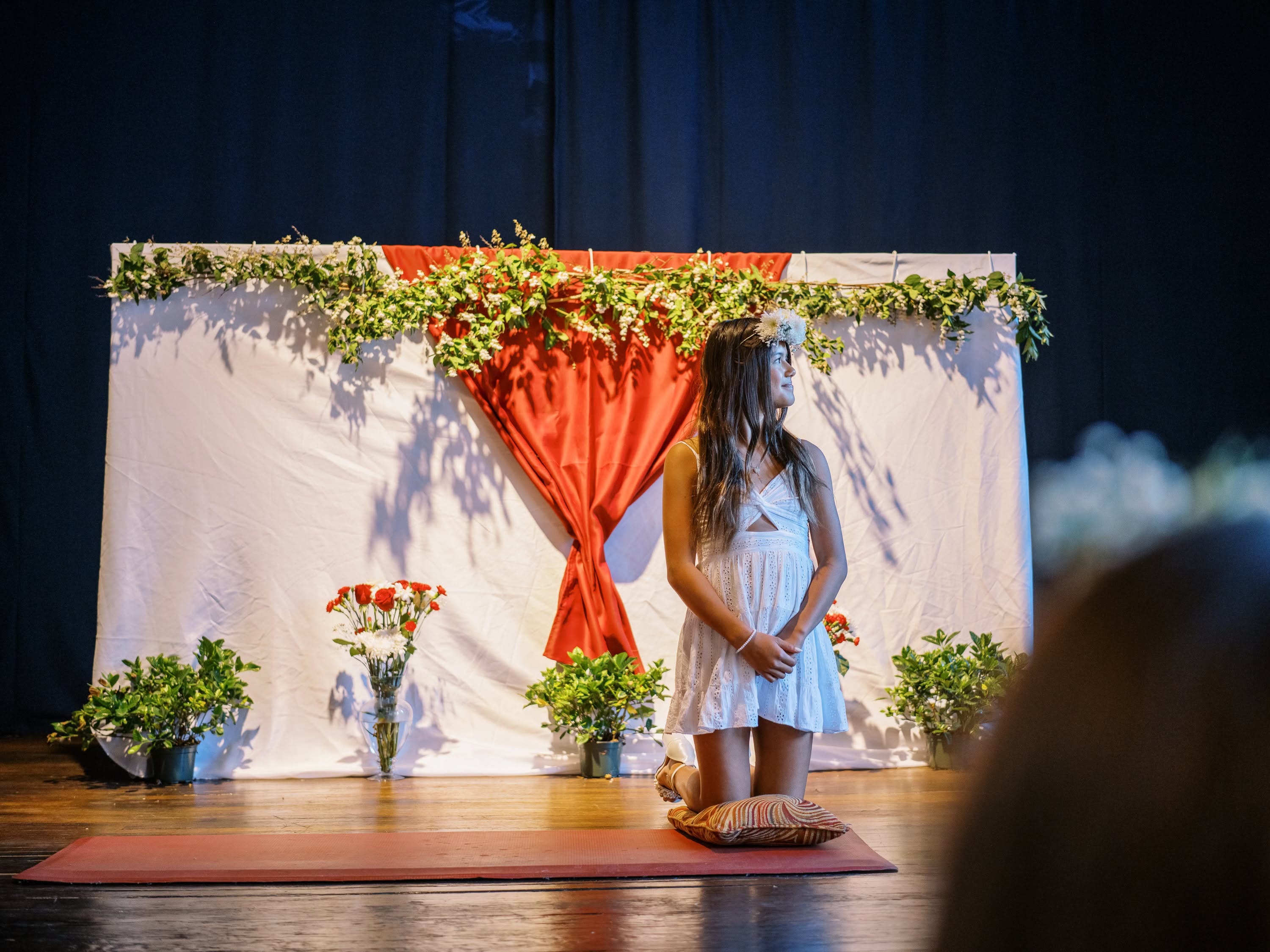
This past week, my sixth grade daughter had her “rising ceremony” at the Waldorf school.
Yes, I know if this was a short story that sentence would give you all sorts of juicy info about this character: she probably bakes bread and cuts her own bangs, invites her daughter to make bouquets from the garden before dinners of zucchini gratin, talks about water as a life force etc etc….
And while I cannot entirely argue with this characterization (though my few attempts at bread have been irrefutably terrible and described by my daughter as “rocky”), I can say that I ended up in the Waldorf school somewhat by accident.
After our family’s foray into homeschooling, I understood school differently: not as simply what one does, an inevitable childhood rite of passage, but as a deeply flawed industrial anachronism limping along in spite of evidence of its failings and absurdities at every turn.
It’s not that I don’t believe in school, per se. It’s just that once you get outside of the paradigm of mainstream school it starts to seem very odd that as a society we’ve decided that being educated means sitting from 8-3 pm every day with twenty-seven other kids of the same age memorizing the same vocabulary from a random text about the Roman Empire and then getting quizzed on it by a computer.
And it’s ironic to me that so many of the people wringing their hands now about the use of AI in education don’t seem to grasp that the reason AI is such a threat is because we’re asking children to behave like computers – if we asked them to be more like humans, the computers wouldn’t be so threatening.

All of this to say, we returned from a spell of homeschool and travel with a newly skeptical take on school, and we landed at Waldorf. They had a space open and Elena visited and wanted to go.
That first year we were a little wary. Did our child just spend an entire year weaving a felt elephant? Yes, she did. Was she really happy doing so and did it probably fulfill basic human desires to work with her hands and settle her nervous system? Also yes!
We noticed Elena really cared about her work. She wanted to do it well, she wanted to make it beautiful, and she owned it. It wasn’t just some object she turned in for a grade (there are no grades). She felt really connected to the school as a community, not just as school. She enjoyed singing and woodworking and drawing and also making new and different projects for each “block” (astronomy, physics, Greek history). She came home from school with energy and life, versus all the prior years of school – both public and private – when she almost always came home depleted and punchy.
In the fall, we learned about the sixth grade “rising ceremony.” The premise of the rising ceremony is that at the start of the year, an adult at the school – it can be a teacher, a staff member, a janitor, anyone – chooses a student to follow over the course of the year. This “sponsor” tends to be someone who is close to the student and knows them well, but they remain hidden; no one will know their sponsor until the rising ceremony.
The sponsor notes how the student grows throughout the year as a person. This is crucial – as a person. That is, not so much academic achievements or accomplishments (reading competition trophy, cross country win, etc) but the student’s human growth. Then, at the rising ceremony, the sponsor gives a little speech about the student and reveals what they have noticed.
At the beginning of the year, the whole middle school (which, at Waldorf, is 30 kids total) takes a camping trip, and on the last day of the trip, each sixth grader is asked to spend a half an hour of quiet time alone in nature to contemplate who they want to become that year.
As someone who meditates daily; who birthed and raised her child on forty acres of pastures and woods in rural Ohio; and who has a dispositional predilection for Deep Soulful Things, this made me swoon. I envisioned her beside the lake, staring with mystical calm and self-knowing at the still waters. My girl, whose greatest skill set is reading other human beings, took great joy in telling me, “Mom, I filed my nails with a rock and made a clay hand mask.”
Anyway, I think some self-actualization wormed its way into her, nails aside. Waldorf has a way of getting to you even if you think you’re too cool for school and would never tearfully sing in rounds.

All year long Elena chattered about the rising ceremony and I knew it was an important event, but I pictured it somewhat like a graduation: the kid crosses the stage, an adult says a few kind words (Henry was a merit scholar in math, etc etc) everyone claps and then we all eat cheese cubes or whatever.
On the day of the ceremony, we gathered in the auditorium. The violin and flute teachers provided gentle acoustics while my parents, niece and I speculated on the possible symbolic meanings of a yoga mat and pillow in the center of the stage.
A few minutes after six, the kids entered. They were attired in white, black, or red, the boys in dress pants and button-downs, the girls in dresses. They all wore gorgeous handwoven flower crowns they’d made that morning. They looked so young and yet tall and proud and gawky: middle-schoolers, still earnest but heading so quickly towards adolescence.
At the start of the ceremony, they recited an oath they had written collectively and memorized. Each sixth grade class choses an “order” – a color and an animal – and they had chosen purple and butterflies. Purple for freedom, justice, and nobility, and butterflies for growth and transformation. Their oath was as follows:
As members of the Order of the Purple Butterflies
We will
Embrace who we are becoming
Find comfort in who we are and who we have been.
Trust in our own ideas and leave space for others’ perspectives
Stand up for others’ needs while honoring our own.
We will
Learn, grow, and give ourselves grace when trying new things.
Be kind to other people and to all living things.
Ask for help when we need it and help others when they need it.
And
Be proud of the unique qualities that each member of this class brings to the community.
Okay, I know I’m a sentimental sucker. But how lovely to hear eleven and twelve-year-olds embrace these nuances and dualities: wanting to become someone new while honoring our previous selves; standing up for what we believe in without closing ourselves off in righteousness; recognizing our own needs in relationship to others; trusting ourselves while remaining open.
The oath embodied what would come through in the rest of that ceremony: a celebration of the uniqueness of the individual, and not for their achievements, but for their distinct personhood.
This is what I think I have spent much of my adulthood trying (and often failing) to respect – each person, no matter how frustrating, no matter how loathsome, has this core of personhood that is unique to them and good in its own way. The person may not lean into that goodness very often, may let the baser sides of themselves prevail, may not appeal much to me because of hideous politics or a predilection for video games or what have you, but they still have that human core: whatever was there when they were a baby and will be there when they die.
And that’s what the rising ceremony was about. It was about being seen as a human being. Really. That was it.

The teacher read each student’s full name, and the student came and knelt on the pillow set on the yoga mat (aha!) before a backdrop of flowers. First, the teacher introduced the student’s shield, because this is Waldorf and so of course each student had made a beautifully designed and hand-drawn shield – what else would one do to culminate sixth grade?
Each shield was unique. Not in your typical school-art-from-a-template way, in which one is purple and one is yellow. I mean they were all entirely different. One, by the daughter of artists I have no doubt will be an artist someday, was an exquisite sunset entirely in soft pastels that could have been exhibited in a gallery. Another was a rose on a black background. Another a jester face and a series of complicated symbols. Another two cats perched on shelves with tea and plants.
The teacher described the symbolism of each shield, as told to her by the student. (“The eye represents your love of drawing…the masks represent different parts of yourself.”) Then, she noted what the student's peers had said about them: how they brought a lot of energy to the class; how they had learned to listen to others this year even when they disagreed; how they made everyone want to dance.
She described what she’d observed as a teacher - how they had apologized at a tender moment, how they’d stood up for a friend with dignity – and also what the parents had shared: the student’s commitment to their dog, their love for the cello, the way they’d cared for a younger sibling.
And finally, she revealed the sponsor. The art teacher! The music teacher! The 4th grade math teacher! Sometimes there were gasps, sometimes knowing mmmmm-hmmmms rippling through the line of sixth graders.
While the sponsor spoke, revealing what they had witnessed over the past year, each sixth grader knelt on that pillow and let this recognition from the community wash over them, and they blushed and their eyes widened and they smiled and sometimes laughed and held back tears or cried with happiness, in awe at being seen.
I have never witnessed anything like it. Each kid was entirely themself. They were not praised for the exceptional – the award, the 1st place win – nor were they praised for banal vague qualities like kindness or leadership, though many were recognized as being kind and good leaders. Rather, they were seen as themselves: what kind of kind they were, what kind of leader, how they moved through the world in the day to day as a human.

After each kid left the stage, even if you had never spoken with them before, you had a clear sense of who they were – the one unafraid to be weird, with the refined taste in music and movies; the one who loved magic cards; the one who made little drawings every day in her music folder; the one who was always giggling and bright.
When the sponsor had finished sharing, they asked, “Do you remember the oath you took?” and the student answered, “Yes,” and the sponsor asked, “Do you promise to live by it?” and the student answered, “Yes,” and the sponsor said, rise, noble heart.
And each time they rose, in heels or dress shoes, flower garlanded, grinning an unselfconscious grin from earlier in childhood, and their sponsor hung the key around their neck.
When it was Elena’s turn, Jorge started crying as soon as the teacher announced that her shield featured flowers to honor Mexico. It was painted orange to represent the sunset, “which always keeps you calm when you are traveling,” and it showed stars to represent her love of wishing on stars. Elena gaped when it was announced that her sponsor was the kindergarten teacher. She thought for sure it’d be the P.E. teacher, for whom she was the teacher’s pet – but he wasn’t a sponsor this year.
Instead, the kindergarten teacher took the stage and described how all the children in her class counted down the days of the week until Elena’s visit. She told a story about how one day, a little girl was having a really rough time, and Elena sat with her and calmed her down and “turned her day around completely.”
I worked hard to keep it together. In homeschool, Elena had volunteered at a local farm preschool, run by a fierce, scrappy Peruvian single mom who had bought a run-down house in rural PA, renovated it, and turned it into a schoolhouse.
Elena mentioned her love of kids and desire to babysit, and this woman invited her to help out. This is what is possible in homeschool. So Elena visited on Fridays, changing diapers, singing songs, pushing babies on the swings. This work was witnessed by no one but the Peruvian teacher, myself, and the children. Elena loved it. It came to her like the desire to write comes to me at the Salt Fort State Park pool: innate, galvanizing, unconcerned with what anyone else thinks or what glory might follow.
Even at a very young age, Elena could hang with a group of adults, teenagers, senior citizens, you name it. When Jorge had an exhibition at the Bronx Documentary Center in New York, we stayed out until nearly 3 a.m., partying and watching soccer at a community garden, and ten-year-old Elena arm-wrestled almost every single person there, dads and college students, kids and grandmas, speakers of multiple languages, Dominicans and Puerto Ricans and Colombians and Chicagoans. She didn’t want to leave.
This kindergarten teacher saw that. She showed the room who Elena is, and Elena knew it. When she rose my heart was in my throat. I’m not sure I’ve ever been seen in such a way, though I have received awards. I have won races. I have stood on stages.
In high school, the valedictorian cited me in her speech, saying “One day, when Sarah Menkedick is writing for The New York Times…” and I did go on and write for The New York Times, and I have used that as shorthand to explain who I am. A writer, but more importantly, a “real” one, a working one.
I thought I’d spend this year telling people I was working on my third book. The same identity shorthand: Ah, Sarah, this is what she does. But that’s not how it worked out. I thought after the rising ceremony about the answer to that question: Who is Sarah?
It reminded me of a meditation exercise we did on the first day of the Mindfulness Based Stress Reduction (MBSR) course, in which we envisioned a box. It could be any box, big or small, wooden or metal, bejeweled or plain. One by one, we were to put our identities in the box. Our work. Our relationships. Our hobbies. The terms we used to define ourselves, imagine ourselves.
When everything was in the box, and we’d lovingly closed it up and set it aside, what was left? Who was there?

Last semester, I received the single best student evaluation of my whole teaching career: “This is the first time I have written an essay without AI,” the student wrote (THE FIRST TIME!). “I really enjoyed writing this semester because I wrote from the heart.”
I banned AI in my classroom, but I also tried to learn who my students were. Even the difficult ones, who sent earnest emails about missing class because of frat parties and who did not engage in any group activities unless I hovered two feet away from them and whose main insight into Naomi Klein was “I don’t get why she thinks so deep about stuff.”
Who are they, because that is what they are writing, and that is what they are figuring out in the writing – the one who was a first generation college student and captured the tension of living out her family’s dream and also wondering what it was all for; the one who grappled with understanding the racism she’d experienced as an immigrant in American high school; the one who wrote over-the-top paragraph-long sentences with eighteen mixed metaphors.
After the rising ceremony the parents and teachers and students mingled and there was a sort of glow in the air, hard to describe, not like accomplishment but like recognition. Like love. An odd, unfamiliar feeling in a school, which should tell us something.

In her groundbreaking book Caring: A Relational Approach to Ethics and Moral Education, the philosopher Nel Noddings warned, “We are limited in our thinking by too great a deference to what is, and what is today is not very attractive.” (Note: this was in the 1980s, and things have arguably only gotten worse!) '“Our alternative is to change the structure of schools and teaching so that caring can flourish, and the hope is that by doing this we may attain both a higher level of cognitive achievement and a more caring, ethical society.”
This is what I see Waldorf doing, above all. It prioritizes beauty and spirituality and weaving felt elephants, yes, but all of that is part of the care of human beings – because if we’re being honest with ourselves, if we’re doing that strange thing that feels anathema in the scrambled modern world and telling the truth, sitting in ordered rows on screens and filling out identical tables in worksheets does not lead to human thriving.
It especially does not lead to children thriving. There can be some of that in school and life, and some humans might choose a lot of it. But right now in most places in the U.S. it is the bulk of what we consider “education.” And many of us can feel this in our own lives, when we try and detach who we are as people from what we produce, earn, and achieve. From the idea that if we aren’t producing, earning, or achieving what everyone recognizes as worthwhile, we’re nobodies.
So here’s to your sixth grade nobody self: the one kneeling on a cushion on a yoga mat in an auditorium, being told they are good. Being told, we see your energy, your weird, your quirk, your laugh, your love of reading, your intensity, your quiet, and we honor it. Being told rise, noble heart.
I hope you’re enjoying Terms of Endearment!
Here you’ll find essays about art, motherhood, travel, books, culture, and more.
This work is free for everyone. A paid subscription supports the labor that goes into it – the time, energy, thought, and care behind each piece.
For $30 a year, you can support writing you care about. Thank you!
Recommendations
My mom will be very glad that I have finally finished this book and am no longer regaling her with facts about the destruction caused by Agent Orange and the speed at which the rainforests are disappearing!
Childbirth Trauma: The Human Rights Issue Nobody Really Cares About. YES, and it’s shocking to me how impossible it is to get people in mainstream media to care. Elizabeth Kulze.
“If you’re an artist or a writer then you know one hopeful, promising truth: creativity cannot be optimized. You can try all you want to keep it organized and contained, but eventually, it comes seeping out the edges.” Thanks for this, Anna Brones.
“One of the other students raised her hand, saying she didn’t understand why it was bad for AI to write stories as long as the stories are based on their ideas. More students spoke: one wanted to know how using AI was any different from using a human editor. Another wanted me to answer why, at a university that launched one of the world’s first AI research programs in 1959, were we even having this debate? Isn’t AI meant to make everyone’s life easier? Less stressful? Isn’t the point of AI to free humans from the tedium of rote tasks?” Excellent piece in The Guardian about AI and teaching writing, with one of the best descriptions I’ve read of what AI writing sounds like.
An absolutely beautiful photo series called “las pelilargas,” or, “the long-haired girls.” Exactly what it sounds like. Hair, but also so much more.
Have a lovely week, friends, and don’t forget to send Terms of endearment to a friend. 💚
Sometimes I will say to a yoga student , as they enter class and I'm standing by the door holding an ipad, 'I can't remember your name but I know your energy'.
this was so beautiful. my heart was in my throat while reading it - thank you.