

On the cusp
Ohio State Park pools, imaginative play with babies, and the numinous

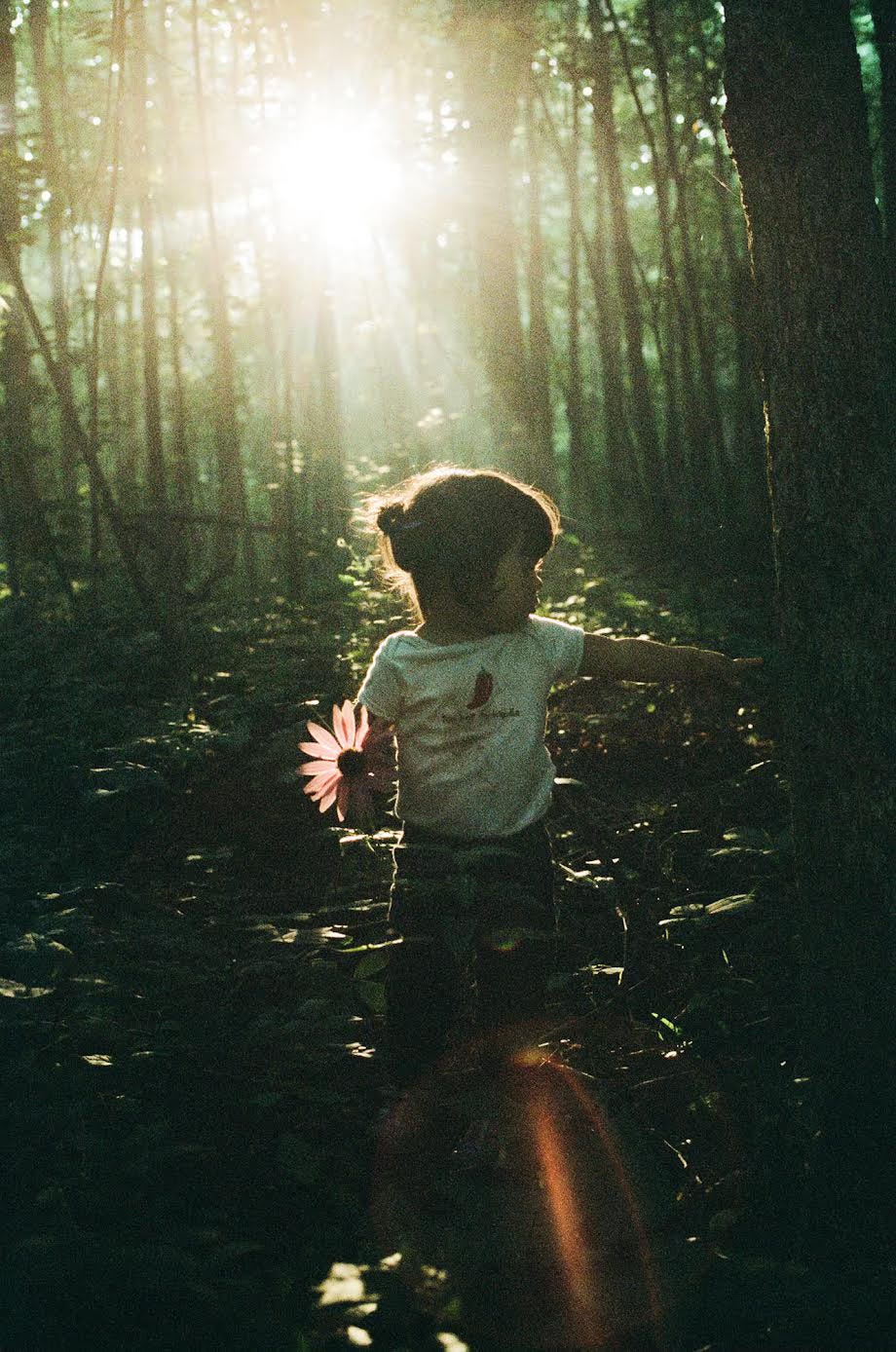
I’m at the Salt Fork State Park Lodge pool, reading a poem. It’s an Ellen Bass poem in the latest New Yorker, entitled “While My Daughter Is in Surgery I Think About a Night in a Hotel in Florence,” and it makes me choke up, glancing around and popping a Wheat Thin in the hopes that no one has noticed.
No one has. If you have not been to the Salt Fork State Park Lodge pool in southeastern Ohio, let me enlighten you:
There is a Russian grandma with spiky blonde hair, a toddler in each arm, and a tattoo of a snarling wolf on her back. There is an Amish family of approximately fifteen children, led by two matriarchs, standing on the first step of the shallow end in full Amish garb, bonnets and all. There is a man with every inch of skin, including his face, tattooed.
There are shirtless men in cargo shorts and muddy work boots, drinking Pepsis at plastic tables and observing the fray. Kids everywhere are launching themselves into the water with splayed limbs, smacking each other with noodles, paddling around in yellow Intex tubes. Toddlers smack their gummy fists on the water’s surface, gone a pearly malachite with excessive chlorine. A dad with a jiggling white belly hurls himself in and shakes off shouting “Grrrrrrr!” like a cartoon grizzly.

In the poem, Ellen Bass tells the story of a night in Florence when she and her daughter returned to their hotel to find their room had accidentally been booked, their luggage packed and waiting behind the desk – and not a single hotel room available anywhere in the city. The hotel finally found a bed for them “deep in the heart/of the heart/of the building.” A tiny chamber of absolute darkness, with clean linens. Bass writes,
What are the names of the nights when
you regret nothing?
When the sorrows that came before and
the sorrows that would come after part
like a stream parts when it bends around
a rock.

Elena and my niece join the fray in the shallow, seizing one of the drifting communal beach balls and starting a two-girl game of volleyball. I hang back, sipping my coffee, holding out as long as possible before being drafted into playing the shark.
I remember when Elena was four and attending preschool at a private school near our house, where we received substantial financial aid. Many of the families jaunted off to some Caribbean idyll for the two-week spring break, but not us. We went to…the Salt Fork State Park Beach. Think: muddy sand, bilious yellow-green water in which various parasitic forms may be nakedly visible on the surface, a lot of geese poop. Elena loved it. We loved it, because it was free, and close, and it had its own Midwestern beauty that I’ve accepted as part of my DNA along with Cheez-its and the expression “jeez.”
When Elena returned to school after the break, several of her classmates swooned about going to the beach. They meant palm-shaded chaises longues before turquoise bays, waterslides followed by virgin piña coladas. “I went to the beach too!” Elena announced. “The diffy beach!” Diffy meaning, of course, “different.” It was so perfect that we still refer to Salt Fork, and many Ohio destinations, as “the diffy beach.”
My niece, who is seven, gets a rubber ducky out of our massive Ikea bag of pool detritus (the wet socks, the Wheat Thins, the soggy grapes) and she and Elena, who is eleven, play with it for a good thirty minutes, inventing great adventures and trials and setbacks for this fluorescent pink plastic waterbird.
At eleven, the veil is thin. Sometimes, Elena still says “Mama” in such a plaintive way that she could be three, chubby and cross and needing a hug. And sometimes, I can almost see the young woman she will be, and it is so painful I have to turn away. I can see her at eighteen, in her college dorm, introducing herself to her roommate. Smiling, “It’s pronounced Eh-len-ah, it’s okay, everyone gets it wrong!” I can’t bear it.
And I think what it might be like after all these years being so busy – trying so hard to figure it all out, desperate for a break in the evening for a beer, lingering at the grocery store because a long bedtime struggle awaits – how much I will miss it.
Why do I seem to learn everything ten years too late? I want to shake my thirty-one-year-old self – so young! – and say, nothing you care about right now matters! Literally nothing!

I spent the morning sitting in the grass with my other niece, the one-year-old, picking dandelions. But not really – that suggests a tidy and discrete activity. Rather, it went more like this: opening and closing the door 7 times; picking 4 dandelions; filling up a discarded plastic container with 17 rocks; wandering up a grassy hill and falling down, crying and getting immediately distracted with the nearest object at hand (a clover); picking 4 more dandelions; opening and closing the gate to the dog run 8 times.
It has been so long since I have operated at that speed, simultaneously frenetic and so, so slow. It is indeed very much like being on psychedelic mushrooms. Everything is fascinating and time doesn’t exist. Someone wagging a daisy in front of your face is enough to bring you out of your deepest despair. Wow!
I remembered how difficult and lovely it is to just bear witness in those years. All you do is watch those eyes widen in surprise at the existence of a shiny rock, at the softness and sturdiness of the cat’s fur. You proffer objects, constantly: a cookie cutter! A chip clip to close chip bags! An empty dog bowl! A random bit of torn paper crushed under someone’s shoe! Wow! None of these objects are put to their intended use. They are stacked, banged together, shoved into other objects, and dropped or thrown from various heights. The whole world is a big wild experiment, unbelievable.

In The Discovery of the Child, Maria Montessori talks about learning to just watch children day in, day out at the school she has founded. In doing so, she develops some of the twentieth century’s most prescient and powerful revelations about childhood, many of which continue to go unheeded today in a society so bent on “productivity,” so obsessed with what is measurable and quantifiable.
In a park in Rome, Montessori observes a boy about 1 1/2 years old, sitting on the ground next to a “superior-looking nurse,” filling a pail with gravel, tiny stone by tiny stone. At some point, the nurse decides it’s time to go, and urges him along, but he refuses to budge from his mission. Finally the nurse simply picks him up, places him in his stroller, and fills the pail herself to the brim with stones, “quite convinced that she had pleased him.” She presents it to him as a gift. But he is furious, crying in an “expression of protest against [this] violence and injustice.” Montessori writes,
“This simple episode forms an illustration of what happens to children all over the world, to the best and most dearly loved of them. They are not understood because the adult judges them by his own standard; he believes that the child is bent upon external projects, and in a friendly way helps him to attain them, whereas the child is dominated unconsciously by the need to develop himself.”
It seems more obvious now than ever that this is not only describing the frustrated ambitions of toddlers, but anyone engaged in a project whose ends and purposes are not established and explicable and direct, for the sheer joy and discovery of it, the thrill of presence – a project much like, say, creating art, or mothering a child.
“Someone who loved him, imagining that his desire was to possess stones, made him unhappy,” Montessori writes. How often we confuse possessing stones with what we really want: to touch the earth and run it through our fingers. To sit in the sunshine under a beloved’s gaze and play.

On the phone that morning my mom told me she was reading a book about meaning and purpose, and that the right brain is so devalued in our culture because it’s not about logic, analytic, or cognitive reasoning, but rather “the numinous.”
“Isn’t that a cool word?” she asks.
Numinous: Merriam Webster’s defines it like this (the caps are theirs!):
1) SUPERNATURAL, MYSTERIOUS
2) filled with a sense of the presence of divinity : HOLY
3) appealing to the higher emotions or to the aesthetic sense : SPIRITUAL

My daughter rarely wants to play babies now. When she does, it is as a guilty pleasure, with a meta-awareness of the fact that she, a preteen, is playing babies. She has shed the guilelessness of early childhood.
But with her smaller niece she can happily travel back to that realm and shake the self-awareness, pretending the ducky is sinking until she is rescued by a brave if reckless dolphin (I do observe that her imaginative play has taken on the storylines of YA romances. I wouldn’t be surprised if she had the duck create a fake post to fool the dolphin on Instagram).

Jorge and I had gone running that morning on the bike trail and discovered a marathon taking place. It went through the nearby city of Cambridge, Ohio, and then coursed ten miles up and down the trail. It was nearly 11 am and the volunteers told us there were only two runners left.
“What an insane marathon,” I said, meaning who would run twenty-six miles in middle-of-nowhere Ohio with zero spectators out and back on a bike trail!? A diffy marathon, for sure.
Jorge and I did our usual run, three miles up and three back, and at mile 2.5 there was a lady with a buzz cut in full camo sitting before a table covered with gels. (For those of you who are blissfully unaware, sports gels are a kind of glutinous alien goo in little aluminum packets, with flavors like strawberry banana and campfire s’mores, uniformly revolting, but helpful).
Jorge, feeling unusually bold and suffering a late-morning energy slump, asked if he could have one.
“We’re not running the marathon,” I specified to the lady.
“Take as many as you want!” she chirped. Bless her. We each had a gel and not a second too soon, because the sky revealed a massive storm bearing down. We turned back and within ten minutes felt the black wing of the approaching front darken our heads and continue advancing. I checked my weather app. “Rain starting in fifteen minutes,” I said. That would necessitate at least an 8-minute mile.
We picked up the pace. In the last half-mile I felt particularly inspired and took it down to 7:30, steady, steady, and the whole time I told myself it’ll be over soon and you won’t remember the suffering, only the experience, a lesson learned from races but most memorably from natural childbirth, in which the suffering was extreme but the reward so extraordinary and unbelievable the pain was instantly forgotten. We made it to the car the exact second the sky opened up with a wild spring hailstorm.
And it was true – in the car I was flush with energy, surprised at myself, already missing the adrenaline of that last push along the meadows darkened by storm. Getting older is getting this little bit of perspective, accrued over time, along with the wisdom to appreciate it. This is what it’ll be like when it’s over. This is what it’ll be like on the other side. So you can do the counterintuitive or difficult thing: run when it hurts, spend a little longer picking daffodils, savor what seems like a misfortune as an unexpected gift.

Numinous: the holy in being able to see what is ending, what is beginning, and the space you occupy in between.
Ellen Bass’s poem is about that bantam chamber where she and her daughter spent the night, apart from the world, no “sound of voices, horns, tires” no leaves or stars or moon, no “pebble clattering down the medieval stones.” A space, a breath, between “endless cycles of birth and/death.”

At the pool, a burly dad is trying to convince his toddler son to enter the water. The boy, skinny and shivering, is reluctant. He has no floaties. His little ribs and knobby knees stick out. He clutches himself. The dad, bearded, with glasses, holds out his big dad hands. He keeps them a few inches from his son’s body, splays them wide so his son can see all his fingers.
“I promise I won’t,” he intones, “I promise.”
Then he holds his hands up in the universal gesture of surrender: no funny play here; no jocular splashing; no unwanted, scary goofiness. The boy takes a little step forward. The dad lowers his hands into a chair, a landing place, as if to say, whenever you’re ready.
The boy does not jump or fall so much as glide into them, and the dad gentles him into the pool. He rides the boy around on the surface of the water without any friction, past and through the chaos, and the boy settles his head on his father’s shoulder.
We gather our things, our pink plastic ducky and our damp shorts and towels and emptied coffee, and we shrug on our shoes, and we go, and they are still there, floating, before the after, after the before, safe.
I hope you’re enjoying Terms of Endearment!
Here you’ll find essays about art, motherhood, travel, books, culture, and more.
This work is free for everyone. A paid subscription supports the labor that goes into it – the time, energy, thought, and care behind each piece.
For $30 a year, you can support writing you care about. Thank you!
Recommendations
I am listening to the audiobook of Famesick and loving it. Loving it. Cannot get enough.
The greatest comeback ever to the doctor who says “Please don’t confuse your Google search with my medical degree” from Zed Zha, MD (she/her) (whose Substack and book both look very intriguing!)
I listened to the audiobook of Katie Kitamura’s Audition on a 10-hour roundtrip drive and was both perpetually confused and absolutely rapt.
Revisiting this classic on writing and it is as good as it was the first time around.
“Nonviolence is not only refusing to harm another person. It is refusing to give up on their humanity.” Kaira Jewel Lingo’s latest newsletter is short and powerful.
At Waldorf, Elena does “handwork,” which is very easy to ridicule because really, you just spent a full year wool-felting a slipper?! But I have seen how calming it is for the students, and it’s reminded me that working with my hands – especially in the garden - really shifts my mood and awareness. Loved Anna Brones’s latest meditation on what we hold in our hands.