

On finding the resplendent quetzal in Costa Rica
On the rainforest, an unexpected communion with international nerds, and hope.

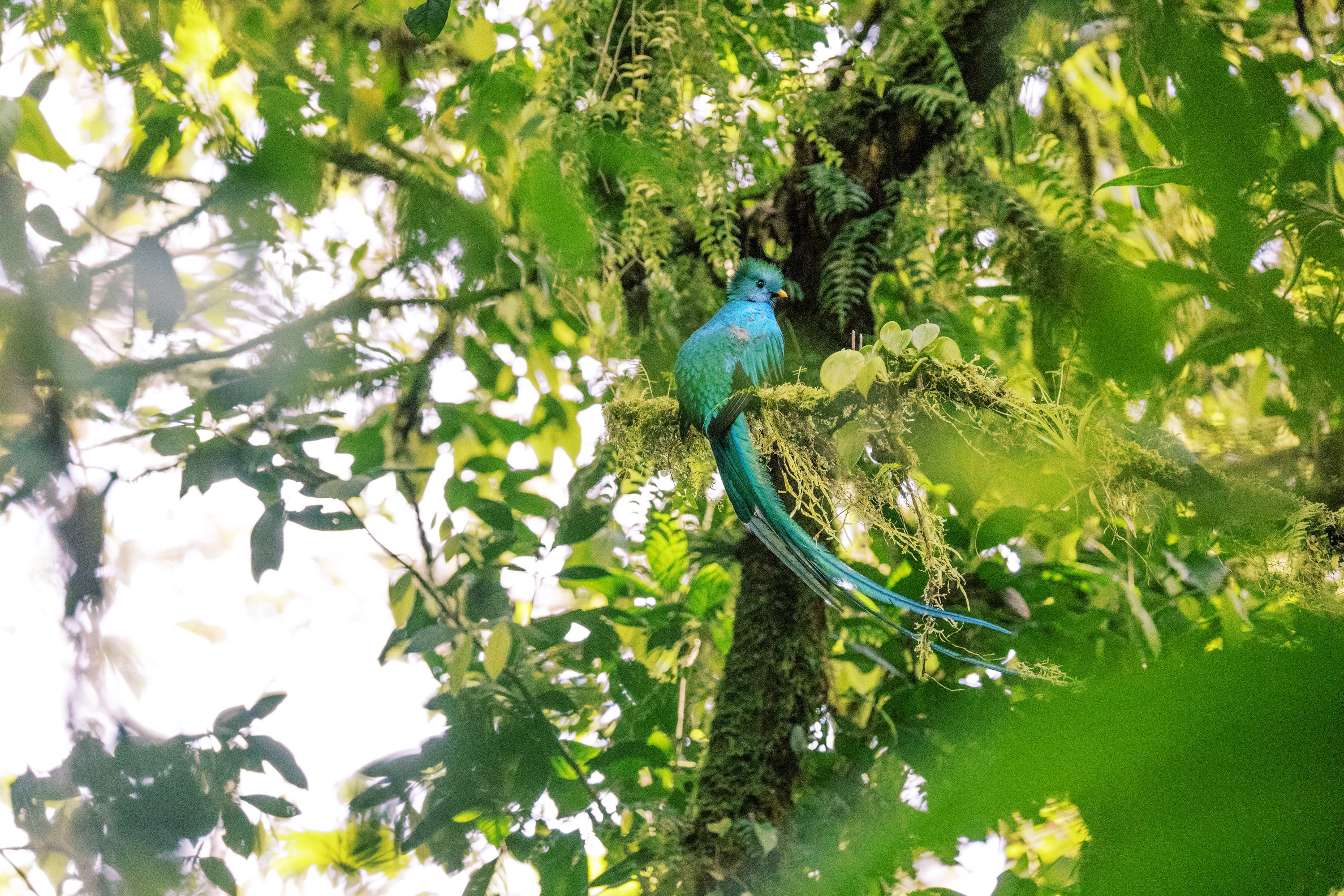
We are seeking the resplendent quetzal. This is the only bird in the world with “resplendent” in its common name, suggesting that even the most data-hardened ornithologist could not resist the shimmer of those emerald tail feathers, the gleam of that scarlet chest in the misty dark of the cloud forest.
The resplendent quetzal is hard to find. Guides, trailing panting Texans in full-body dry-fit athleisure, trek with single-minded glares through the sun and gloom, stopping occasionally to interrogate the canopy with their binoculars. My dad, Jorge, Elena and I move at a glacial pace, studying the overlapping patterns of greens like a magic eye puzzle, refreshing our memory of the bird’s call on Merlin.
In K’iche (Guatemalan) Mayan, the word for quetzal is the onomatopoeic “q’uq,” and in Yucatecan Mayan it’s k’uk: each sounds in English like “coo, coo” but at the highest octave of soprano, and voiced from the very back of the throat. It’s unmistakable, utterly unlike the polite piano trill of the warbler, or the dove’s sweet morning song. It’s cute and puppyish and also wild, the kind of forest cry that snaps you to your senses.
When we finally hear it, three quarters of the way through our hike in the Monteverde Cloud Forest Reserve, we begin stalking. I understand the hunger of Hemingway and big game hunters. All of us creep, alert. Even Elena, who is at peak middle school coolness and thus has an innate allergy to people whispering things like, “Could that be the tody motmot’s mating call?”
Elena has dubbed the quetzal “the pretzel,” an homage to my dad’s obsession with pretzels. This obsession is an ongoing joke in our family ever since Dad first came to Mexico many years ago and uttered the phrase, “What do you mean, they don’t have pretzels in Mexico?” (Update for the curious: Mexico has, in the intervening fifteen years, gotten pretzels. You can get them at Wal-Mart, which unlike in the U.S. is a very fancy place where people go in heels and skin-tight blazer-tank-top sets, and Pringles cost $10). Dad is a big believer in pretzels as a basic global necessity, and they are essential in his book for any real game of cards. Somewhere in the hunt for his mini-Snyders of choice Elena confounded the quetzal with the pretzel and the two merged into a mythical gringo quest.
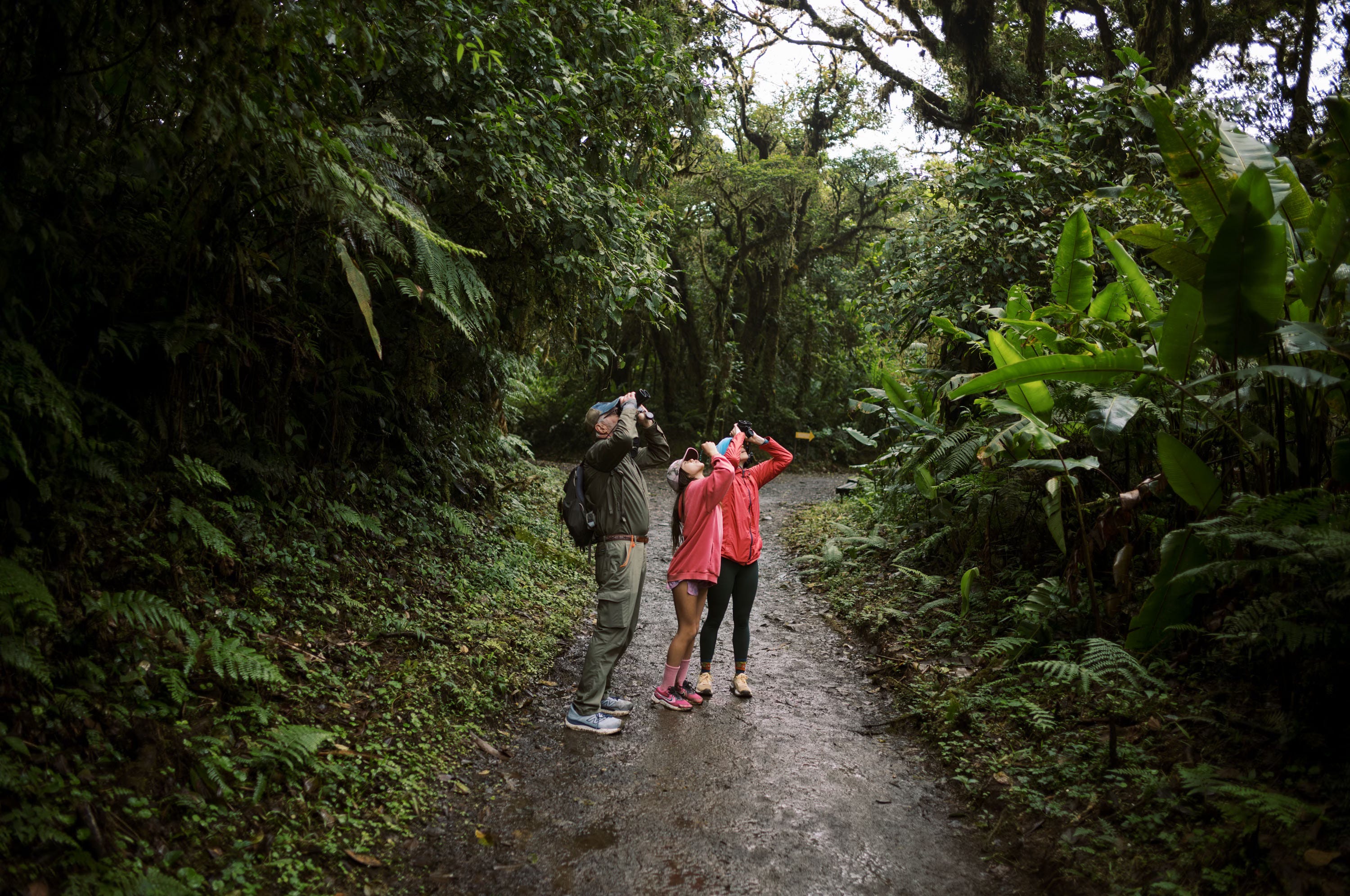
“Off to find the pretzel!” she’d singsong in the mornings as we prepared for the day’s hike, or, “Did you see the pretzel?” or “Look, there’s a pretzel!” to mess with us. But she understood, beneath the joking, the sacredness of the pretzel-quetzal. The motmots and the trogons and even the toucanets she admired for a moment and then turned from in her preteen reveries, but the pretzel was on another level.
One travels for this: for the eleven-year-old to feel in her veins that a bird contains magic, and that if we find it, that magic will touch us.
The quetzal became real like some dreams do: very suddenly. One minute it seems you’ll never find it and you’ll be haunted by its elusiveness forever, and the next you hear it, that otherworldly coo coo: part puppy, part baby, part siren goddess.
Jorge held up a finger meaning, there! Silence! We tiptoed. We squinted and scanned from trunk to treetop. Then we rounded a corner and there it was, perched on a branch like an apparition, a psilocybin hallucination. Its colors were the most luxurious and unbelievable in the Pantone lexicon: beryl, aquamarine, carmine, viridian. Its tail was over a foot long, drifting in the breeze like a jellyfish in mild waters; its head was fuzzy; its eyes shone deep and dreamy and black. It echoed the palette of the cloud forest and elevated it with an aquatic-metallic sheen: it glowed.
We were silent. There was no one else on the trail. All around us, cloud forest. Epiphytes dangling from branches like fuzzy green confetti in the mist; ferns the size of maple trees unfurling their soft tendrils and fanning their palms; whole ecosystems growing from twenty-foot-wide ficus trees –mosses and flowering bromeliads and leafy green plants and smaller trees; and above, a criss-crossing canopy of greens that made the sky seem remote.
A cool, intimate world unto itself, and in the middle of it, this gem.
Wow, we kept saying, wow wow wow. More prayer than word. It was like we’d entered a portal to some ancient time, some ancient part of ourselves. The part that worshipped a plumed serpent, cherished a feather more than gold, punished the capture and slaughter of this creature with death. The part so connected to the forest that a bird became divine.
Into this portal entered a hip young Australian couple in cheeky shorts and fanny packs. Hers had a pin featuring Jesus, his arms spread wide from a cartoon cloud, a caption beneath reading, “You are all disappointments.”
They sensed the energy immediately. “Quetzal,” I whispered, and I don’t know if they even knew what it was, but they followed my instructions – up the tree, through the fork, to the right, see? They gasped and stared with the naked eye since they didn’t have binoculars.
Then came three Germans. They were young girls in hiking gear and tank tops and Euro sneakers, their skin dewy and fresh and free of makeup. Their leader – a little taller and bolder than the rest – whispered, “What do you see?”
I guided the Germans through the maze of tree limbs and layers to the turquoise shock of the quetzal, and the leader gushed, “It’s so beautiful. Oh my God, it’s so beautiful.” She covered her mouth.
The German girls had no binoculars, had not been looking for the quetzal, had no particular sense of the quetzal’s significance as a rare or important bird, but stayed there gazing at it for over two hours. I lent them my binoculars a couple of times and they passed them back and forth, teaching each other how to locate the bird from that unfamiliar perspective, drawing a sharp breath each time they found it, its foot-long tail soft as silk and drifting cerulean in the breeze, its eyes wet opal pools. They traced its body with the binos, each lingering as long as she could before relinquishing the gaze to her companion.
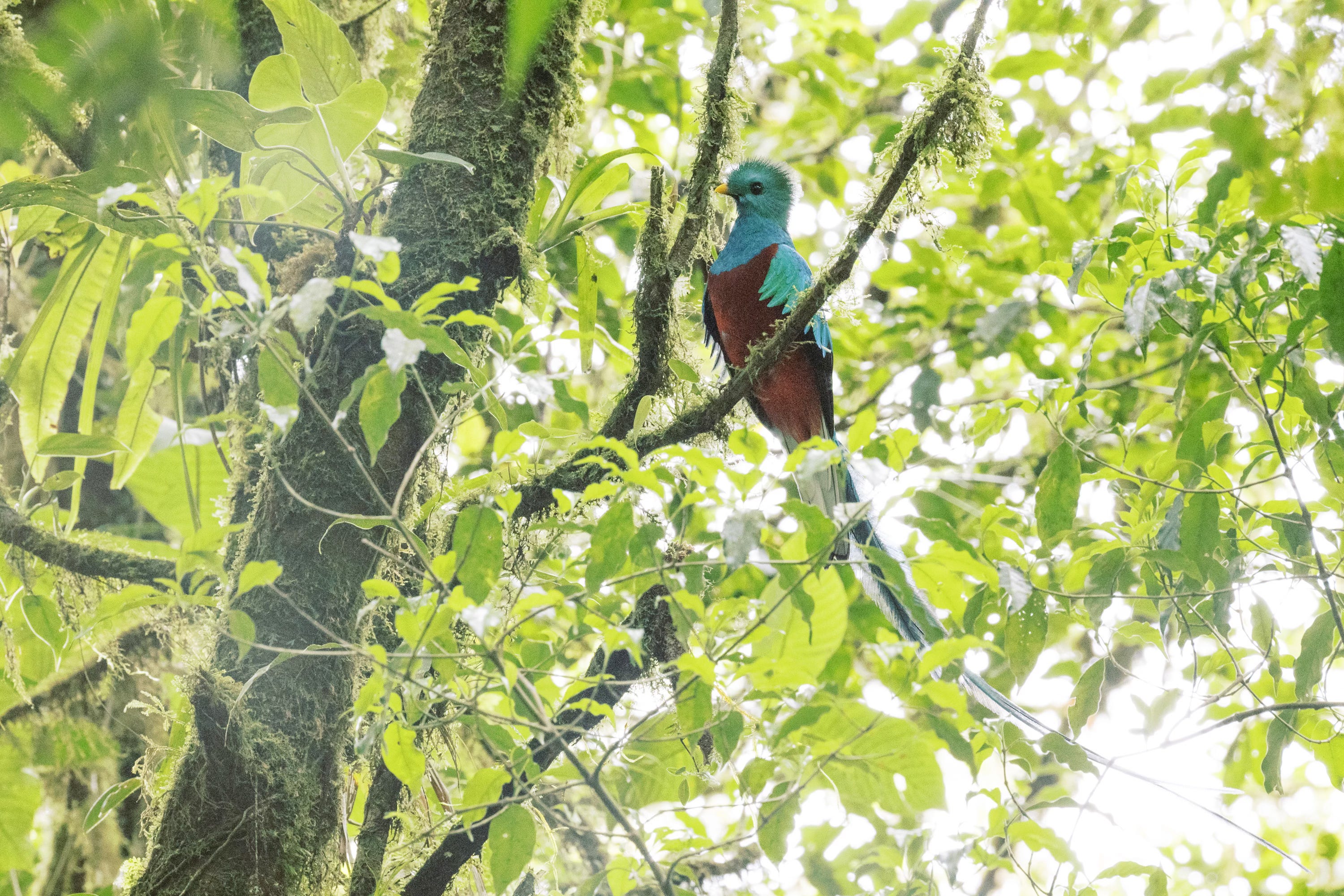
What followed was like a song, a refrain that repeats with slight variations in kind and number: The Ants Go Marching On; The 12 days of Christmas. Two Australians, one with mustache and one with Jesus pin; three young German girls; an American couple with a boy about Elena’s age; a Spanish-speaking gay couple who clutched each other as they stared as if on a rollercoaster; two elderly Australians who tiptoed under all the cameras; four young people from somewhere in Latin America with Ciencia Latina stickers on their backpacks and mushroom ornaments dangling from their zippers; two older Swiss couples with elaborate hiking poles and complex backpacks and dour expressions; thin elegant Frenchies with toddlers, always the Frenchies in the middle of the wilderness with toddlers. And on, and on. Every five minutes or so, a new kind of tourist rounded the bend, and each entered the reverie.
In a moment of distressing human disconnect and AI obsession, it gives me faith that everyone who came along that trail understood immediately that they’d entered a kind of cathedral. They needed no signs, no warnings, no hushing or shushing. They just knew when they rounded the bend. And some would whisper for guidance and some would hover and wait for the mystery to reveal itself, but all sensed the sacred. Not a single person spoke out loud, or laughed, or chitchatted, or violated that space. Not even the littlest toddlers. We stared together, silent, as if remembering something so lost we’ve forgotten we grieve it.
The Germans took on the role of ambassadors, mastering the art of locating the quetzal with descriptions that varied depending on age and nationality. Each time, a gasp, a silence when the seeker finally realized what they were seeking. And then a lingering, watching. Most people had no binoculars and the quetzal was a good fifty feet away. But they didn’t care. Its resplendence was right there, palpable and powerful. When it flew off for a stretch, the little American boy planted his feet and said, defiant, “It’ll be back.” My heart leapt for a kid willing to just stand and wait in the chill of this ancient forest for what he knew was something serious and important and real.
My kid, meanwhile, stared for a long while at the pretzel, and then made her way quietly up and down the growing line of observers, enjoying the human spectacle as much as the ornithological, glimpsing the bird from up and down, close and far, with her binos and her eyes, and extricating Haribo Twin Snakes from Jorge’s backpack as if performing an incredibly delicate surgery, so as not to make a single plasticky crinkle. It reminded me of when I’d go to the movies with my mom as a kid, and right at the fragile beginning someone would rip open a bag of Reese’s Pieces and a collective wave of outrage and condemnation would ripple down the soiled aisles of the AMC. So it was with the quetzal. Not one wanted to offend with so much as a single crunch.
It was like the theater when the lights go down and everyone holds their breath. It was like church. It was like the feeling of the Cathedral in Oaxaca with its heavy wooden pews and incense air and subtle echoes, a space where people bow their heads and wait, pray, exit the dull human parameters of their lives. It was like this with the quetzal.
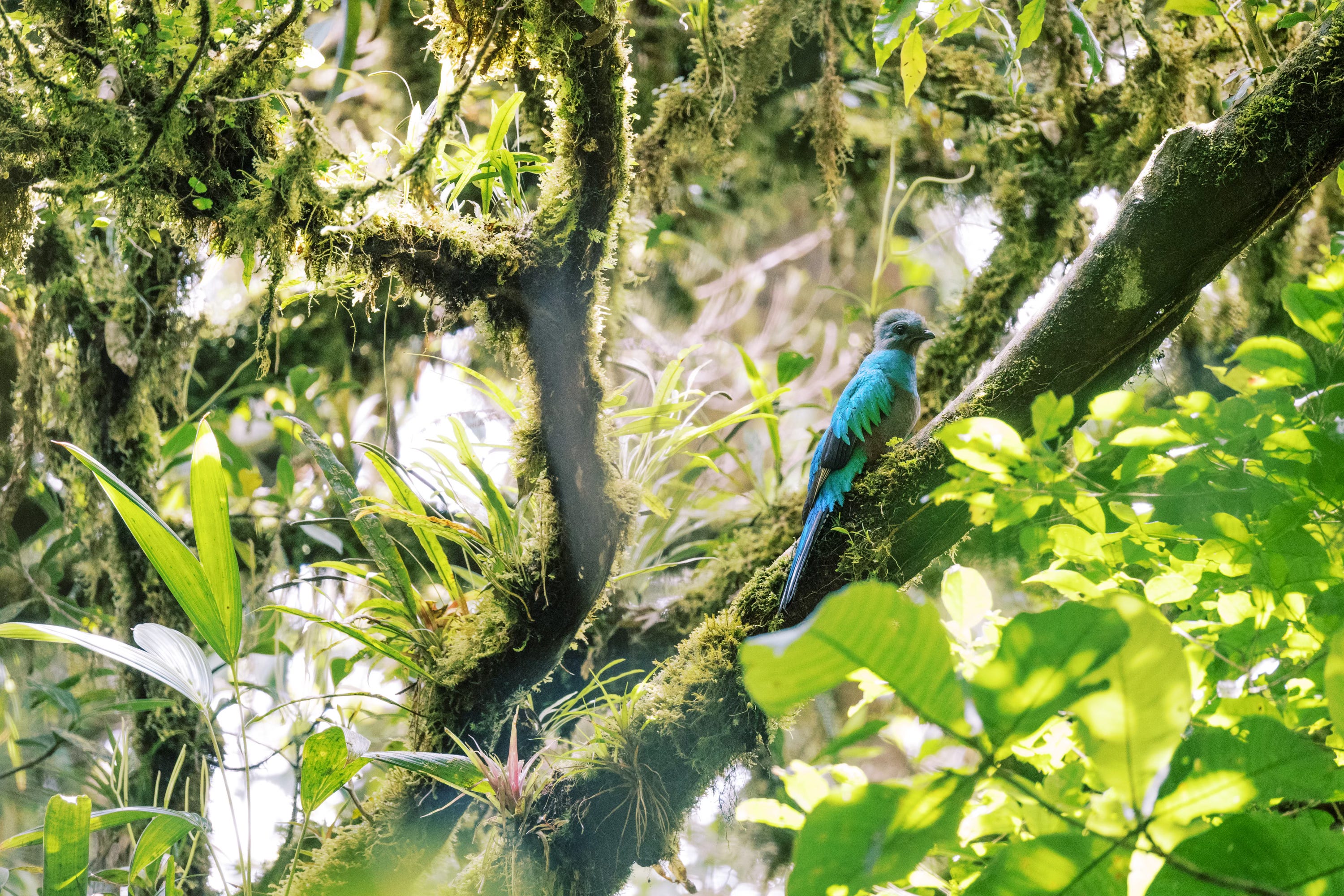
Its feathers are mesmeric, a spectacle of glimmer that makes the human head swim. It felt impossible that this exists and that we go about our days in spite of it, sending emails and buying dog food. Getting mad and eating chips. We stand in a line, us humans with our water bottles and backpacks, our Gore-Tex shoes and little hats and fancy technical versions of sticks and handheld digital devices that expand and retract, and we experience awe. We, who believe we are this supreme animal who can create coal-fired power plants and electric cars and massive data centers to write essays for us, stand still and ogle the mere existence of this magnificent bird.
In his lecture for Pittsburgh Arts and Lectures, the historian and writer Sunil Amrith conducted a thought experiment with the crowd.
“If I asked you if human well-being was dependent on clean water, clean air, healthy land, you would probably say yes, right?” A murmur of ascension.
And yet, he continued, we have built our entire civilization in the last five hundred years on the opposite premise. On the notion that our progress and flourishing is actually dependent on the exploitation of nature. We have inhabited a posture of human exceptionalism that would make no sense to any premodern society, and that makes no sense to ours if one takes a moment to think about it.
Amrith opened his lecture by recounting how he endured catastrophic flooding in Bangkok in 2012, and how scientists predicted that this city of nearly 12 million people will be mostly underwater by 2050. The day after the flooding, everyone was back to business as if nothing had happened.
“The risk,” he said, “had become invisible.” Just like birds, like the names of plants, like our need for nature have become invisible.
Howard Zahniser, an early conservationist and executive director of the Wilderness Society, wrote, “We have a profound, a fundamental need for areas of wilderness–a need that is not only recreational but spiritual, educational, scientific, essential to our true understanding of ourselves, our culture, our own natures, and our place in all nature.”
We watch the light play on the quetzal’s sapphire feathers. We watch its stillness and its subtlest movements, its liquid eye take in what we can’t see. We watch and we can’t stop watching. We photograph, we film, and then we just witness. And the witnessing feels like being in a way we haven’t been in a long time, but have craved. Mesmerized, humbled, connected, sacred. We glance sideways at each other from time to time, smile, move out of each other’s way a step or two. Hours go by like this. The sun and clouds come and go.
And then the quetzal leaves. Like that, it’s gone, a mortal creature after all, in search of buttery baby avocados like all the rest of us. The energy that has held the air so crisp and tight for the long spell of afternoon dissolves, and everyone smiles and sighs and shrugs and unpeels their last granola bar and begins the trek out.
A guide shows up a few minutes after it’s left. “It’s March,” he says angrily. “It’s not supposed to breed yet. It’s too early. It’s supposed to be March.”
Researchers have found that common bird migration routes have fifteen percent fewer birds than they did in 1987 – an average of 309 birds less. The quetzal has survived largely because of collaborations between U.S. nonprofits and funders and indigenous and local communities across Central America. The U.S. Department of State, which supplies funding for the Organization for Tropical Studies in Costa Rica via USAID and makes conservation and research possible, withdrew its funding in 2024.
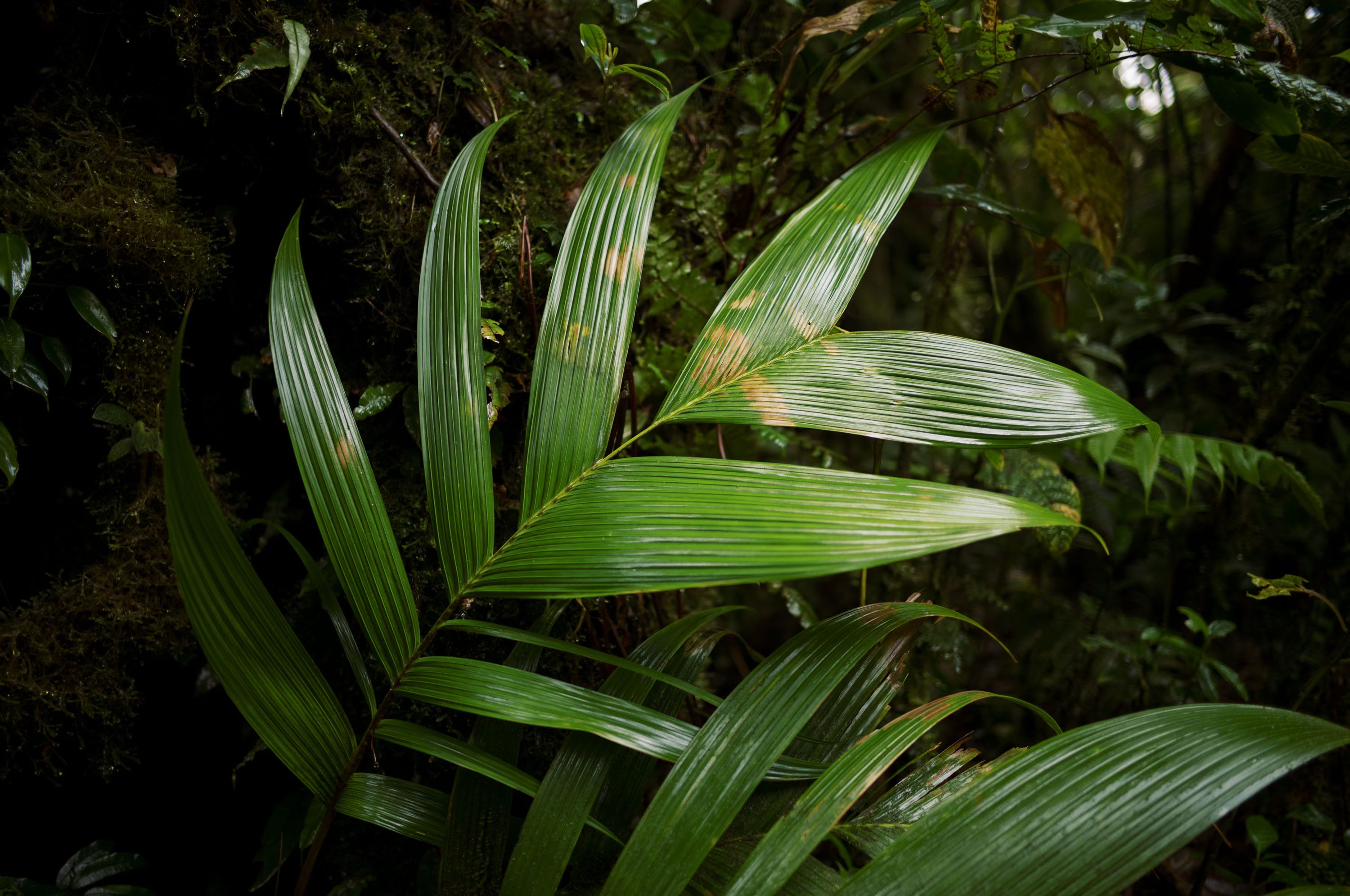
The cloud forest is crucial to the quetzal, providing it the specific species of avocado tree that serves as its main source of food, and the quetzal is crucial to the cloud forest, regurgitating the avocado seeds to plant new trees. Deforestation from industry and agriculture are constant threats to these old growth forests, but ecotourism has helped to keep them alive.
“Resplendent Quetzals,” wrote Cornell ornithologist Alan F. Poole, “have become the ‘flagship species’ for cloud forest conservation in Central America because of something more ineffable than money. It’s what they do to us.”
The laconic Swiss group comes up in the parking lot after the hike and asks to see Jorge’s photos, and for taciturn Germanic folk wearing utterly practical rainproof button-downs they offer a veritable outpouring of emotion. We have seen hardly an upturn of the mouth in the three times we’ve encountered them on hikes, but now they grin and give Jorge the thumbs-up and one even gently pats him on the shoulder and says well done. For an American this is the cultural equivalent of weeping and screaming “Holy shit!” In the shuttle back to the main visitor center, which is packed to the gills with sweaty tired humans, the three German girls end up right in front of us. We nod at each other like we share a secret, like we’ll go home dreaming of this shared vision.
Later I’ll have what my little brother, a fellow artist and deep thinker, calls a Nasty Realization, though I recognize most mildly perceptive humans have probably had it before me. The rainforest has been destroyed in large part because it can’t be commodified, I tell Jorge. It is, by its nature, local and small scale and incredibly intricate, something that must be known at the level of the leaf. You can’t farm it, market it, turn it into a chain or a corporation, replicate it. It defies, by its very diversity, human greed. And so it is burnt, cut, exploited – converted to cows, oil, and cash.
But that longing for what the rainforest represents– that intimacy and connection with the natural world, that authentic abundance – is still in us as a subterranean longing. The quetzal summons it and casts a spell. The feeling lingers, over fried plantains and gallo pinto (always fried plantains and gallo pinto), and through the remaining hikes and days in Costa Rica, and even on the plane ride back home where a nice guy named Bryan who works as an industrial plant supervisor in Arkansas shares pretzels with Elena. We saw the resplendent quetzal.
Jonathan Maslow, the author of Bird of Life, Bird of Death, a 1986 National Book Award finalist about the quetzal in Guatemala, wrote that the bird “has been a symbol of liberty for several thousand years – not the shrill, defiant liberty of the eagle, but the serene and innocent liberty of the child at play.”
Play is being lost in our society. Girls are tearing their ACLs in sports at record rates, and one theory is that they aren’t playing enough – they aren’t climbing trees and scaling fences, roughhousing in the woods, learning to move their bodies in natural and agile ways that protect the knees. They’re just going straight to intensive sport. We are becoming more and more of a monoculture: all of us fed the algorithms of our preferred tribe, dedicating ourselves to a single intensive activity, receiving AI suggestions to read and write our emails, offered ever more of what we don’t want or need: stimulation, entertainment, distraction, waste.
We need the rainforest. We desperately need, for our planet and souls, its diversity and health. But we also need its ethos. A wild space not exploited for human “progress” but existing for its own splendor: our little blue-green planet in this vast universe, conjuring the resplendent quetzal out of oxygen and carbon and the miracle of an avocado tree. Producing not one, not two, but six different kinds of motmots. Not one, not two, but six varieties of toucan. Three poison frogs, one that Elena dubs the “fashion frog” because it looks like it’s wearing a skin-tight red top and blue jeans.
We need play without competition or purpose. We need awe and wonder. We need community that emerges naturally out of a shared sense of humility before that which is so much greater than us. We need what we cannot control. We need the quetzal.
That is why so many of us stood there in silence. That is why, binoculars or not, scientific knowledge or not, tired legs or not, young or old or Australian or Mexican, we lingered so long.
“Hope,” Jane Hirshfield wrote, “is the hardest thing we carry.” It is a rainforest thing: intricate and exquisite and painful and demanding and complex, and suddenly so resplendent we can’t stand it, we pull aside each newcomer and say, do you see it? Do you see it? There.
Terms of endearment is a labor of love. For $5/month or $30/year, become a paid subscriber and support art you care about. Thank you!
Recommendations
My friend Julia has published an absolutely brilliant book that has gotten rave reviews and that you should 1000% read no matter what, but especially if you are a) a woman b) a writer/artist c) a traveler or other roving-type soul d) have ever described yourself as “hell on wheels.”
This New Yorker story on surrogacy is absolutely bonkers.
I am listening to this audiobook on Johnson & Johnson and wow, it is dark. Really makes you reconsider everything you’ve been told about the pharmaceutical industry and the FDA (and it’s by a fairly staid NYT reporter, not a crazy conspiracy theorist!) Hard to stomach but very informative.
Check out Jorge’s absolutely stunning photos of birds from Costa Rica.
Sunil Amrith’s book, which I bought at his lecture this week but haven’t read yet.
An is-it-spring-yet mood.
This essay brought me to tears. For so many reasons, but mostly because I am heading to Monteverde this month with my 4 and 8-year-old, and I've been worrying over logistics and booking tours and hoping they see specific wildlife. But your essay reminded me that no matter what, they are going to see the rainforest and be surrounded by nature's magic and beauty and awe. (But I still really hope we see a quetzal.) Thank you for your beautiful words and mind.