
The humble years
Hip parties, greatness, and being no one

The other night the dog was restless.
Elena had a friend over and they were playing Barbies. Vigorous, exuberant sixth grade Barbies: a very different rendition from second or first grade Barbies, when the goal was sincerity, somber re-enactment. Sixth grade Barbies involves both Barbies and an elaborate show to prove that one no longer takes Barbies seriously: chopping their hair, adorning them with grotesque painted-on crop tops, chucking them across the room.
The dog finds this too exciting. At first the girls let him in and he puts a whole Barbie head in his mouth and flees, ecstatic. The girls, screeching, clamber down the stairs after him and make a big game of cornering him, scoring the Barbie and fleeing in retreat to their room. This goes on two or three times until the girls tire of it but the dog does not, and sits outside their door, whining.
I have 66 student essays to grade.
I put the dog in his kennel but he won’t stop whining. I try saying “shush” as a command, and giving him a treat, but there are two shrieking preteen girls in the next room and a whole lot of interesting hard plastic objects scattered across the floor and the tiny bit of freeze-dried turkey I’m offering is met with contempt.
The sun is setting; russet alpenglow illumes the canopy of Schenley Park. I am trying to concentrate and failing. The girls go to the trampoline and I can hear them giggling, the dog can hear them giggling. He groans like an old man, in exaggerated despair. “SHUSH!” I yell. His fuzzy little ears flatten all the way back, the way they do when a train passes. I’m sorry, I say. He is quiet.
I finish my essays. The girls say goodbye. The alpenglow fades to starry blue, evening now at 6 o’clock. I make dinner and think about the goal of meditation: a quarter second between stimulus and response. A quarter second before the reaction.
I think about how I could have left the room to avoid being triggered by the whining, but then I also could have just taken him out of his kennel, gone outside, sat on the back steps, and watched the alpenglow and the girls bouncing in their sixth grade joy.
I think about how pretty much the only thing of meaning I have learned in the past eleven years is that the act of care is always the act of making the more difficult and uncomfortable choice, now, for the gradual and challenging but ultimately profound purpose of relationship.
Whatever immediate desire I have, productivity or relief or satisfaction, will pale in comparison to that commitment to another being, and the slow burn of meaning behind it. Will pale in comparison to that commitment to myself, to supersede my impatient reaction for real presence, whose rewards are both invisible and essential.
Elena and I went to a party at a Chilean’s extremely hip loft in the Hill District: a space with tattered wooden doors covered with old Latin American newspaper ads, and a wood-burning stove next to wall-length windows looking out on abandoned lots, and exposed brick, and hand-built wooden staircases winding to bedrooms like treehouses, and a Day of the Dead altar covered in black-and-white photos and sugar skulls and flowers and candles. The place filled up with artists who were way cooler than us with much better haircuts and glasses.
I started a conversation with one, an older man who let it be known in posture and attitude that he was distinguished. That who was I. In the past, I would’ve made a subtle but steady effort to show just who I was, throwing in little accomplishments here and there, building my resume. Now, I just asked him about photographing for National Geographic. About the cold in the Sahara. Not flattering, not indulging, just listening as something to do at dusk on a Saturday in November. We parted ways amicably and he circulated and I went and sat with my dog by the fire.
For a while, I felt bad for myself. I have worked hard, as a writer, and some of it has “paid off” and a lot of it hasn’t, though of course it all depends on how we define those terms: money? Renown? Audience? If I define them by purely personal standards, there have been big triumphs and big failures. More, lately, of the latter.
I am no one, I thought by the fire with the Pittsburgh evening going rose and then umber. Here I am, at 43, and I have little to add to these conversations of prestige and accomplishment: the old ones whose trajectory has wound down and the hot young ones whose trajectory is shooting up gesturing brightly at one another with little clay cups of wine. I am just sitting on the couch with my dog by the fire.
Of course, this is ridiculous. We are all no one. 99.9 percent of the human population has no idea who D.H. Lawrence was. Only a self-important twenty-two-year old could sigh with such pomposity at the travesty of her squandered potential when maybe, if she was lucky, she would’ve written one line that someone a hundred years from now would remember. But I’m still that self-important twenty-two-year old. She still screams and writhes within me, puts the dog in his kennel, gnashes her teeth.
These, however, are the humble years. I have been struggling to find a term for them, this time between forty and forty-five, with kids getting a bit older, with life a bit more settled and plants to tend to and oatmeal in Ikea storage tubs, when that first desperate and hungry early surge of career, in which it seemed everything was possible, has flattened into midlife uncertainty, and suddenly the possibility appears on the horizon that a whole life could pass and – gasp, wait for it – one could actually not do anything great.
Later into the night at the party, I found myself seated at a small table next to the distinguished old man. He’d had several glasses of red wine by then, and we talked about China. He still did not ask me anything about what I did, and I still did not care. Apropos of nothing, he said, “You have a great kid and a great dog.” He signaled at Elena, who’d been entertaining herself all evening painting sugar skulls, lounging on the couch with Latin American artists, and eating an entire bowl of meringues despite my appalled admonishments about potluck etiquette. The dog was asleep under the table.
Ha, I thought, I may not have that success I dreamed about every morning running, every long drive through the countryside, every time I finished an excruciating section of a chapter, that thing I’ve worked for and worked for, and instead I’ll have a great kid and a great dog. And what irony, universe, for you to show me that I’ve envisioned this as the consolation prize.
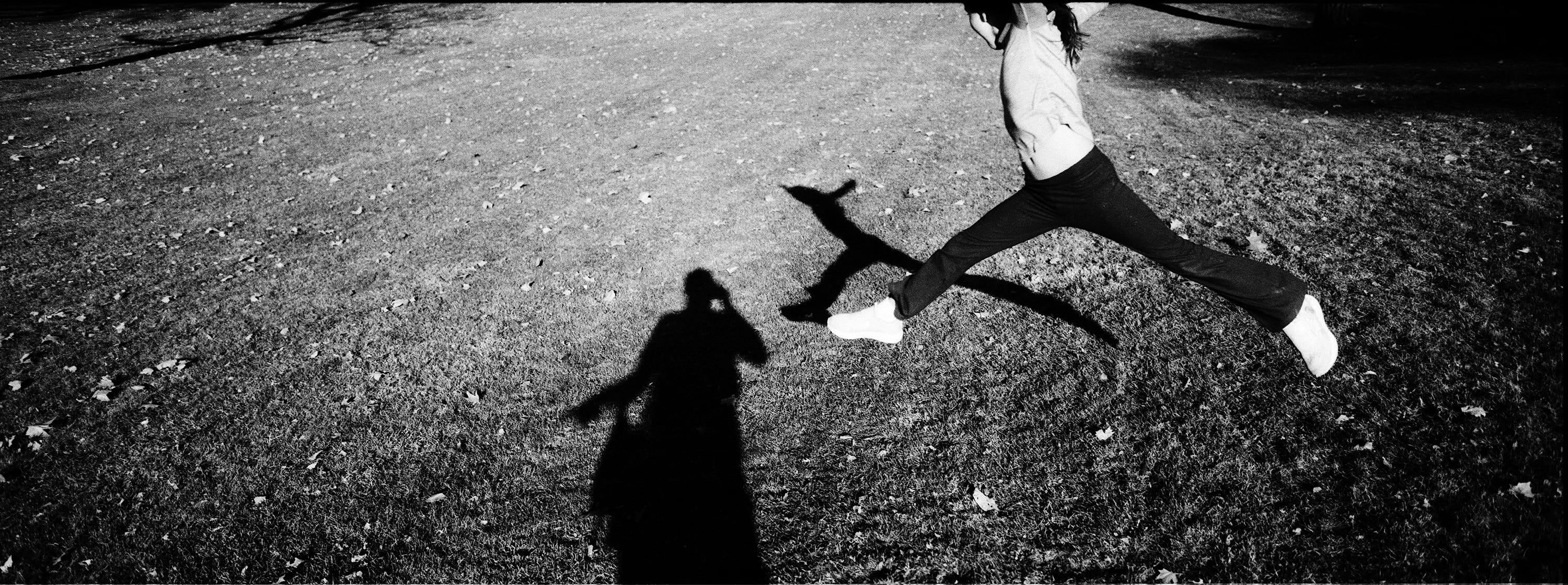
Thank God, I think, for humility. For these humble years. Because maybe I would have gone two, three more decades riding high on success before I realized that I had a great kid and a great dog. Before I let the little fuzzy man, as I call him, out of his crate to catch that crimson radiance on the hills, to watch my daughter’s leaping body in the blink of an eye between childhood and adolescence.
The humble years. What does one short span of human years on earth add up to? Should we even be adding, or simply taking notes? What if I just stopped asking for a little while, was here, right now, making pumpkin pancakes, reading poetry, lacing up soccer cleats, catching the hay-and-navy morning light from the bus stop, greeting the sycamores, listening to Hot Cross Buns on the flute for the 1700th time, lighting candles for the dead, eating Halloween candy, washing the pillowcases, feeding the chickens, long runs, Sunday hikes, porch beers, boba tea, 66 essays, Barbies?
“Staring at the tree for a long time now,” Ada Limón writes of encountering a half-burned madrone in the Mayacama mountains,
“I am reminded
of the righteousness I had before the scorch
of time. I miss who I was. I miss who we all were
before we were this: half-alive to the brightening sky,
half-dead already.”
I ask my students to read Ada Limón and one of them says, “I actually really enjoyed this.” The humble years: that’ll do, for freshman composition.
The humble years. Limón writes,
“Language, I love it, but it is of the air, and we are of the earth.”
Of the earth. Earthly things. Lying in bed by lamplight, reading, Elena’s body next to mine, still seeking the comfort of proximity. The night outside cold and sharp already with winter frost. The dog curled up on the giant squishmellow chipmunk he’s adopted as his bed. I ask Elena if she wants to hear a poem and she lifts a skeptical eyebrow. Is this a cringey mom thing? She agrees, reluctantly, and I read her Ada Limón’s “Sea Turtle,”
“I kept
My distance and laughed
And pointed and was full
Of surprise and the best part?
Every sound I made
Disappeared in the waves.”
I look at her and wait for her sixth-grade sass. She is contemplative. The humble years.
“Mom,” she says, “I thought that was going to be boring, but it was actually really pretty.”
Recommendations
This audiobook if you want something very aristocratic and old school to enjoy on long drives.
Oliver Burkeman’s newsletter.
Only a few chapters in and this book is insane!!!
“Ask me if I speak for the snail and I will tell you
What are you reading lately, my friends? Watching? Listening to? Share and say hello below.
This was just the right essay for me today, Sarah! Beautifully written and beautiful sentiment. Thank you.
Making time to read your essays never disappoints. Thank you for this.