

Muscle Beach, Santa Monica
California, art, and pain

This essay is part of a new series of travel diaries I'll be working on over the next year. These pieces will be shorter, impressionistic, and regular, a way of paying attention and marking time. I’m aiming to publish one each Monday.
The goal here is to give you that sense of place and propulsion that comes from travel writing, which has always been my favorite genre even with all of its problematic history. Travel writing – mostly notably Bruce Chatwin’s In Patagonia, which I read on a bus…in Patagonia – made me want to be a writer, and travel gave me something to write about.
One of the elements I love most about travel is how it etches the everyday into relief: each cup of coffee, sunset, conversation, odd scrawl of graffiti. Everything is worth paying attention to; everything is story. My family is currently at a month-long artist residency in Los Angeles, and on the side of the arts center where we’re staying is a statement painted in bold, black letters: “Our Lives Begin And End In Stories.”
Of course, travel also comes with its hardships and, for me especially, anxieties. I still gasp audibly and to the great embarrassment of my family whenever the plane makes the slightest dip. I worry about the fact that the studios we’re living in here are across the street from a cement factory. There is so. much. bureaucracy. There are little fears and big fears, little hiccups and major hiccups. Stories help. They make sense; they share; they soothe.
I want these dispatches to be crisp, vivid, and sharp, a weekly invitation to see your own life like a traveler – the particular way people greet one another, the slant of the light, the trees. Come along for the ride.

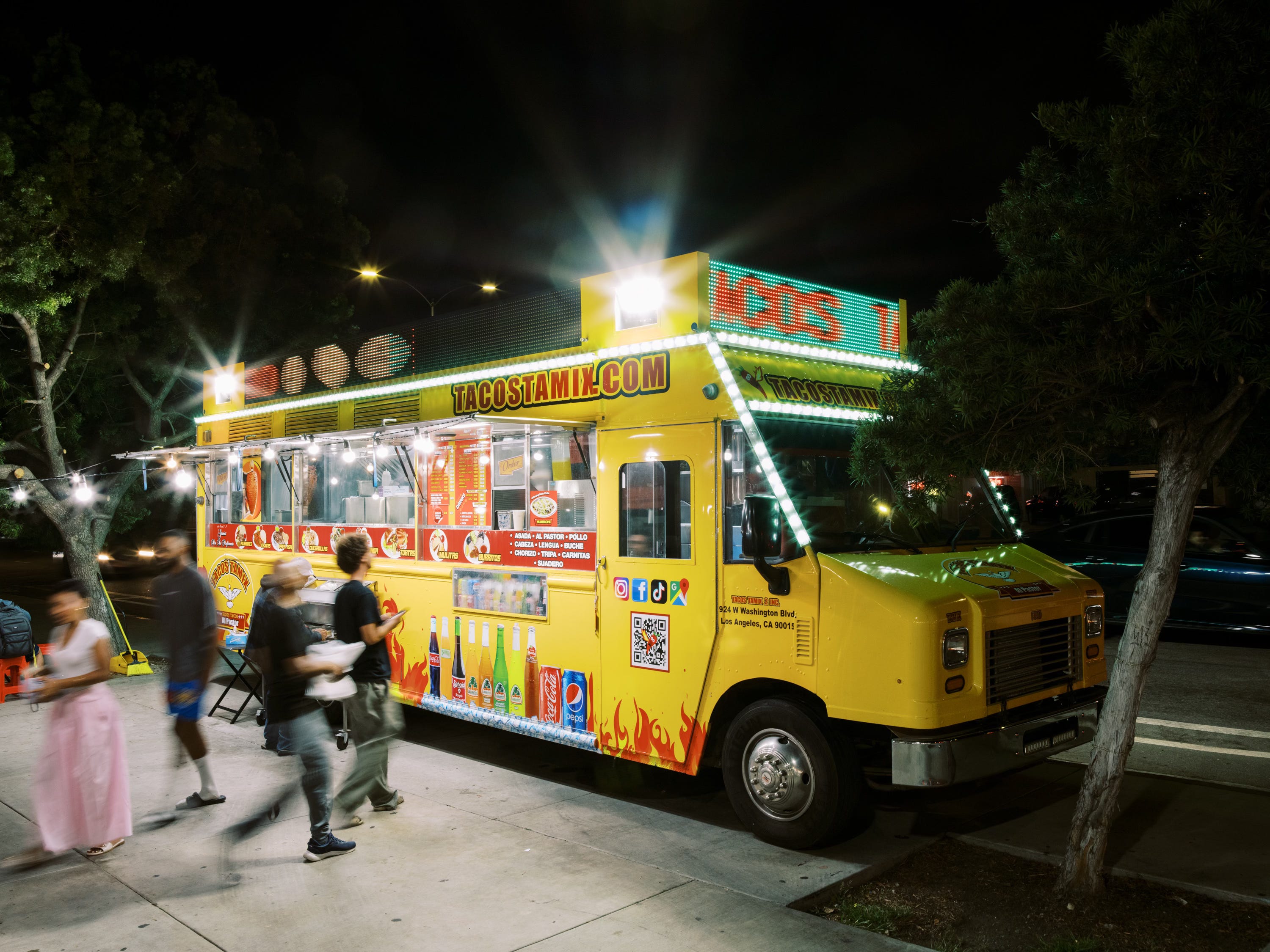
We landed in L.A. at dusk, then stood in an interminable line for our rental car while the California sun sank behind the palms, then went straight for tacos at Tacos Tamix under 1-10 a half-mile from the airport.
It was exactly like arriving in Oaxaca, in that the tacos were off the charts, we were speaking Spanish within five minutes of arrival, and everyone was Oaxacan, except that there were superhighways veering off in every direction and personal injury billboards on every corner. Bienvenidos a Oaxacalifornia!
Immediately we got the sense of L.A. as a microcosm for the American dream: impossibly fit rich white people doing breathwork and eating artisanal blueberry ricotta gelato and a vast brown underclass doing pretty much everything else.
In between live the artists, lovely artists, sharing beef stew and growing butterfly weed and trying their best to make turbo-charged 21st-century capitalism livable and beautiful. We are here for a residency at the 18th Street Artist Studios in Santa Monica, where we’ll spend a month living with other artists in a converted warehouse.
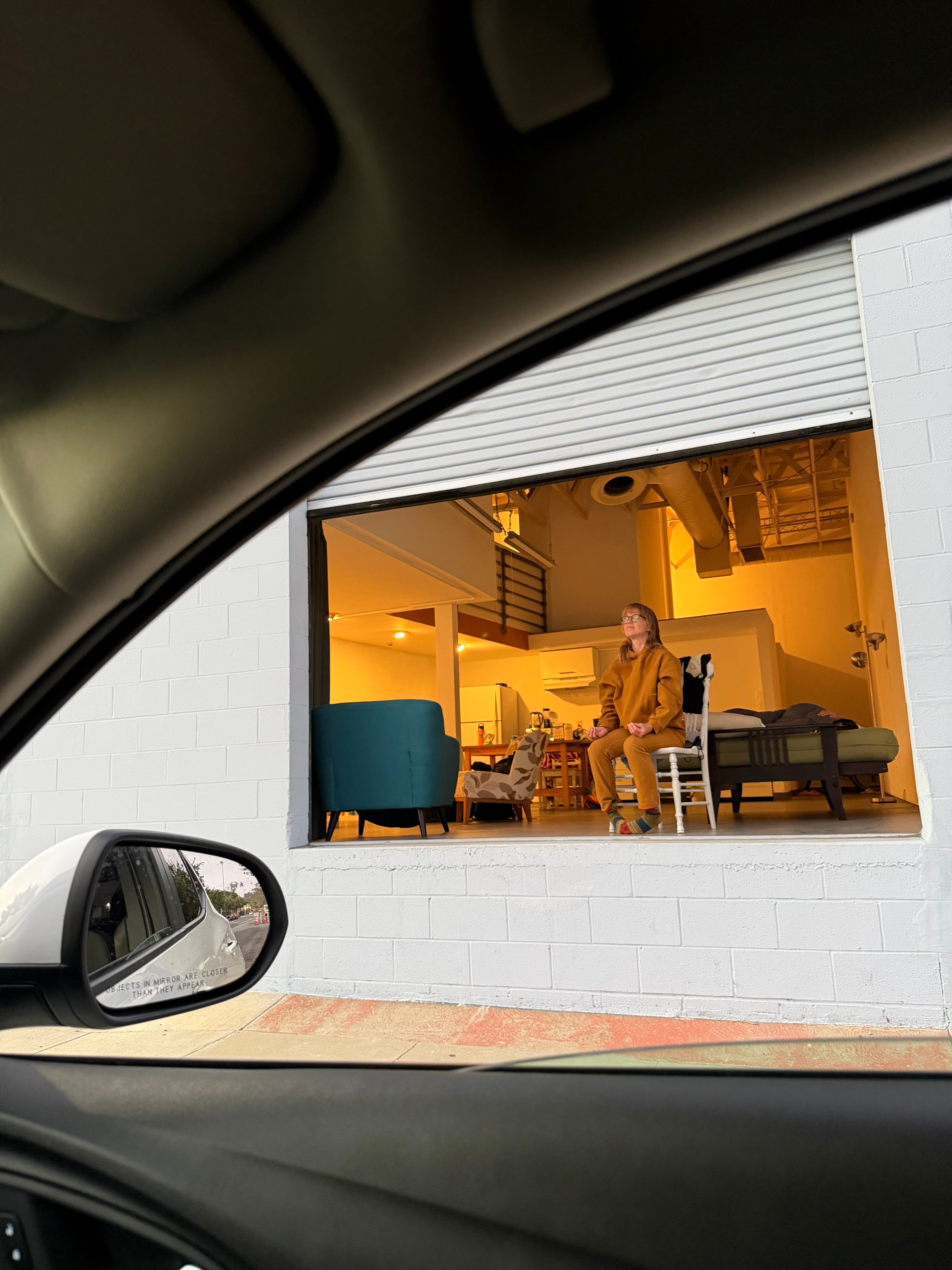
Our studio apartment has one of those rolling garage doors used by storefronts, and when we roll it open an entire wall of the studio is open to the street. This makes life feel like a piece of performance art. The street is a dead end so there isn’t much foot or car traffic, and the view is of the Metro line, palms, and a school sports center across the street. We sit on mismatched armchairs and read, we eat bowls of oatmeal, I meditate on a paint-splattered wooden chair, all before the California sky and the passing train.
The other day I rolled the door up and there were two guys passing and they looked shocked, like the fourth wall had just dropped and revealed they’d been living in a theater this whole time.
“That makes a good breeze!” one said. “You gonna invite us in?” the other asked and I said, “Come on in!” and they laughed and walked on.
One night when I was meditating, wearing an oversized mustard-colored sweatshirt and mustard-colored fleece pants that matched entirely by accident because these were simply the warmest items I’d packed, a Tesla drove down the dead-end and made a U-Turn. The headlights lit me up as the car turned and the woman driving stopped, rolled down her window, and gawked. I think she thought I was some kind of avant garde statue, a piece of absurd contemporary art, and maybe I was. Mustard Meditator, 2026, Sarah Menkedick.
On our first morning here we wandered around dazed at 6:15 a.m., still on East Coast time, and the only coffee shop open was a Starbucks on the bougie pedestrian street. We waited for our coffees beside a young woman with a French bulldog in a vest and a young woman with long, gorgeous, curly hair, the type of curls that look loose and effortless but that you know take some maintenance. We all admired the French bulldog in the vest and then I said to the woman with the curls, “You have gorgeous hair.”
“Thank you!” she said. “You two are beautiful!” I laughed because she was 100 percent looking at Elena and I admired her generosity for lumping me in, and she asked Elena, “Are you half Asian?” She was Asian and she and Elena shared some facial features. Elena shook her head.
“Mexican.”
“She has kind of a choose-your-ethnicity vibe,” I said.
“Yeah, she could totally be Filipina,” the woman said.
“What’s your background?” I asked.
“I’m half Japanese,” she said. I asked her if she spoke Japanese and she confirmed she did.
“See?” I said to Elena, being the most annoying mother on Earth. “She speaks a second language!”
“Do you not speak Spanish?” the woman asked.
“I do,” Elena said. “I just don’t want to.”
“Oh you have to,” the woman gushed. “You seriously have to. You gotta do it, okay? This is your sign from the universe. Being bilingual is the biggest flex. I go to Japan like for months at a time to practice. My sister doesn’t and she speaks way less than me. Do it, okay?”
Bless this woman. There is a special place in heaven for hip, gorgeous young people who urge impressionable youth to do nerdy things like speak other languages and read.
We said goodbye and went out into the cool morning, where extremely tanned and ragged homeless people slept in turquoise oversized Adirondack chairs while a running group, a yuppie army of lithe young people in understated athleisure, jogged by on the boulevard. Later, in the Trader Joe’s parking lot, I saw a Tesla with the license plate BSANDERS.
Californians overall, I will boldly generalize from one week of being here, seem much more constitutionally earnest than East Coasters, who are friendlier than stereotypes suggest but also a cynical lot. I think this is why I have always been more drawn to California – my weaknesses are sentimentality, excessive earthiness, unironic use of the word “healing.”
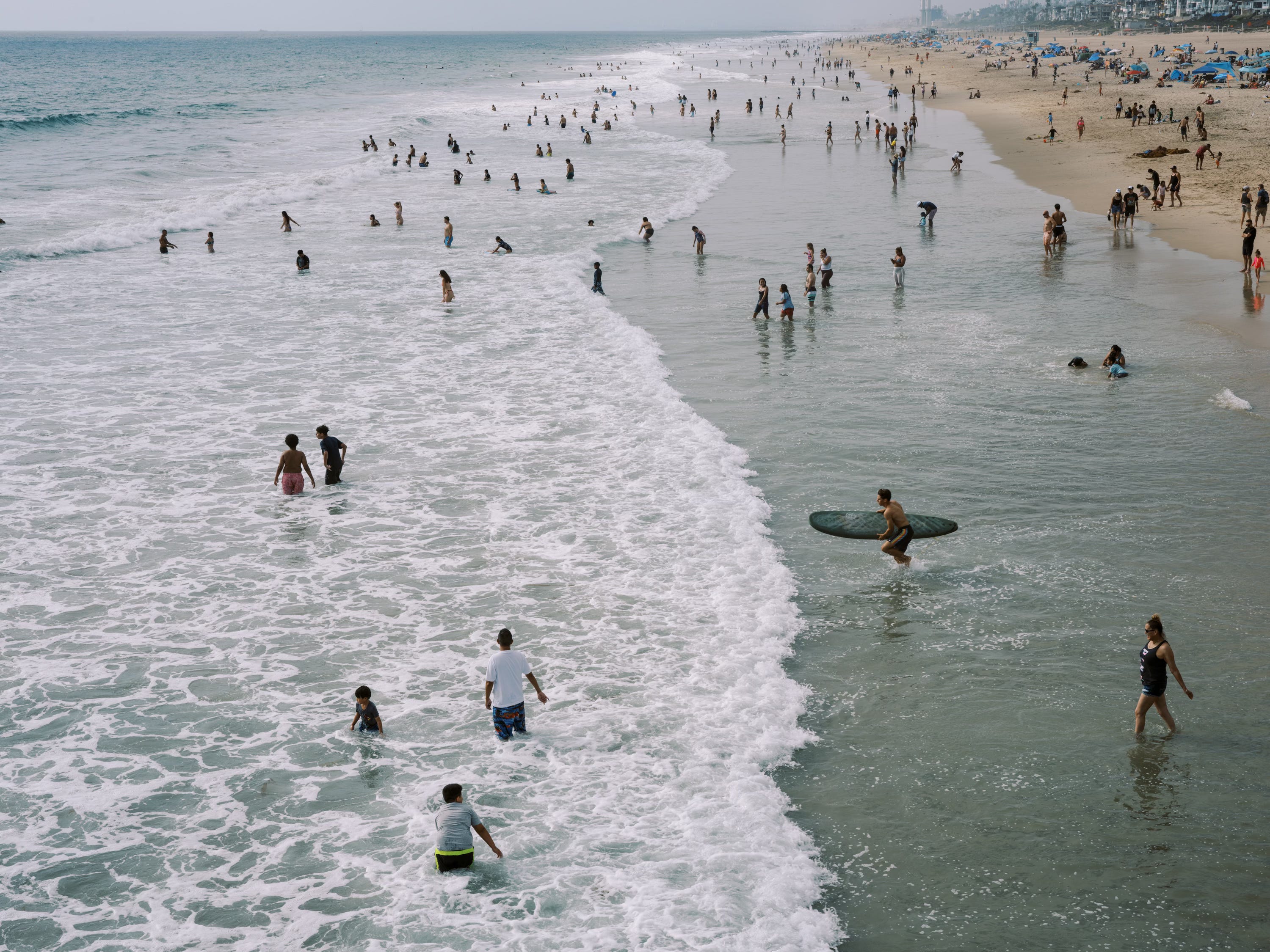
In the afternoons, Elena and I go to the beach and bodysurf. It’s been stunning to me on this trip how wild California beaches remain, even ones pressed right up to the city. It’s possible to run or sit on quieter stretches of beach and still feel that thrill of wilderness, all white sand and beryl water and dry mountains.
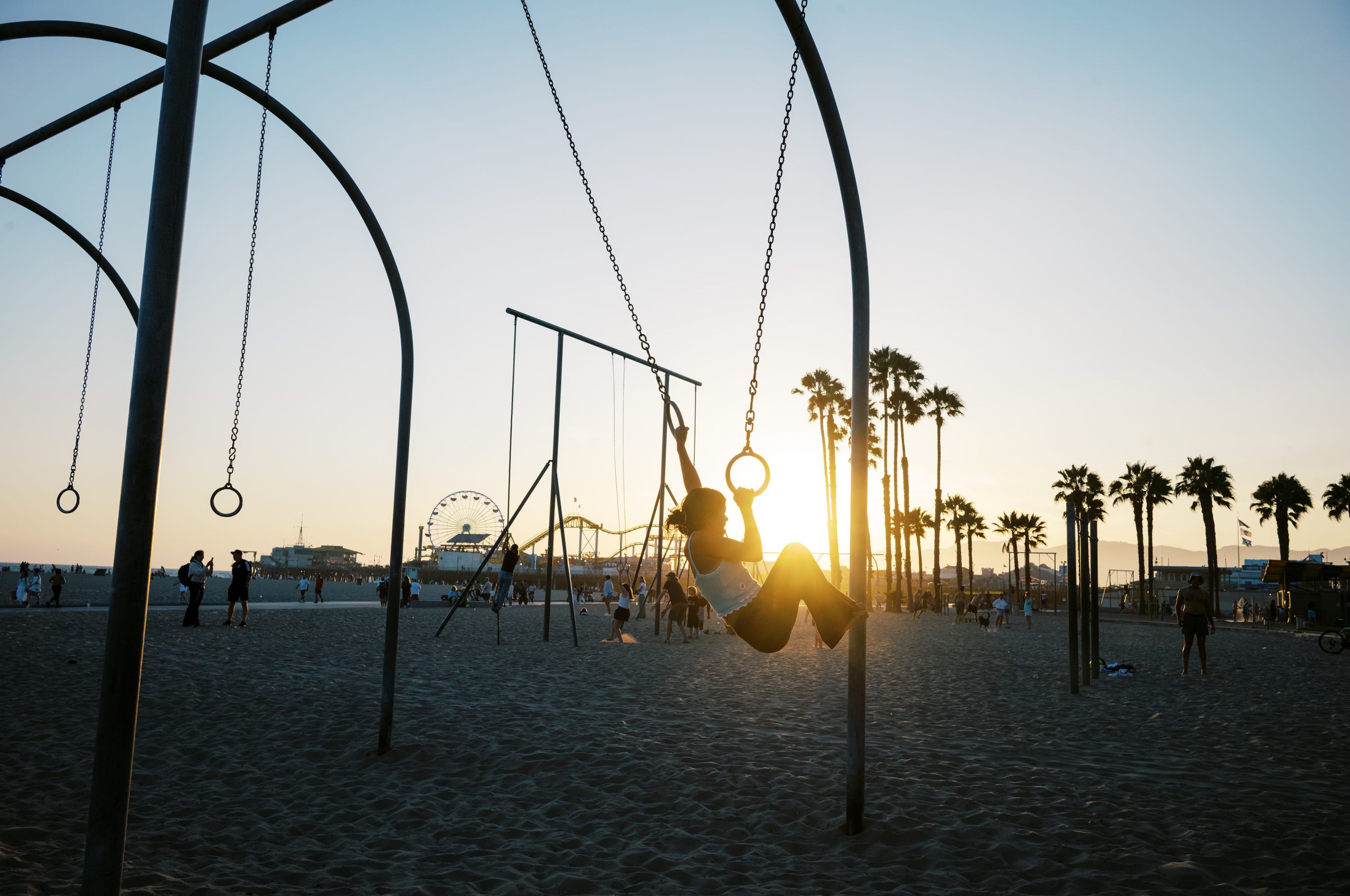
One day, Elena became obsessed with the rings fixture on Muscle Beach, a stretch of Santa Monica Beach dominated by slack lines, monkey and pull-up bars, and weird new-age contraptions that obscenely ripped people use for handstands. At any given time in this section of the beach there is a 90-pound blonde woman with extensive plastic surgery holding her whole body perfectly upside down on two wooden balls, a dude who looks like Jack Black doing back flips on a tiny strip of suspended plastic, and a French tourist trying to scale a thirty-foot rope in wide-legged linen pants.
The rings are a series of ten bare metal hoops set about ten-ish feet apart high over the sand, the aim being to swing single-armed from ring to ring like an ape. This looks simple and is very difficult. I am ashamed to say I was one of the many tourists who felt bold and confident giving it a go and then promptly plopped into the sand after exactly one ring, looking stunned.
But intense athleticism is Elena’s jam. On her first try, she got four rings. Then she was locked in. She had to figure it out. So we spent the next two hours there, me standing in my wet jean shorts and her waiting in line, chalking up her hands, swinging and falling, learning. She befriended a Korean-American guy who lent her his grips and taught her the technique of hunching her body up to get momentum.
I noticed that tourists would often cut the line and simply start swinging on the rings. They didn’t realize that there was a system at work, that the idea was to swing from ring to ring, and that each person took a turn and then waited in a line to the side for another.
Sometimes they were innocent, realizing how the system functioned once they felt seven sets of eyes on them, and then apologizing or hustling their kids away. Sometimes they were obnoxious, holding their kids up and taking photos for five minutes, jumping in to try and dangle from a ring while someone was in the middle of a run across. I began to get righteous with Jorge.
“Why does no one here tell them to stop?” I asked.
“California?” he shrugged.
“It’s gotta be a West Coast thing,” I said. “On the East Coast someone already would have yelled at them.”
Twenty minutes later – still there, sun descending, Elena on her 200th attempt – a woman arrived. She was wide-hipped, with long curly hair, wearing a pretty silk floral dress, not tan at all. She had her son with her. They got in line. A group of young European dudes, possibly drunk, came crashing into the rings, shoving each other and dangling and laughing.
“Hey!” This woman said. “There’s a line.” They sobered up instantly and hustled out of the way, and I had to do it.
“Excuse me,” I asked her quietly, “but are you from the East Coast?”
“Yes!” She replied, shocked. “How did you know?”
She was from Rhode Island and it turned out she had family in Squirrel Hill. Elena asked her how it was possible to do the rings without it hurting her hands so much.
“It’s just pain,” the woman said, the way you might say, “It’s just an ant,” to a toddler screaming in horror at the small insect on their arm. I had felt that pain in the 1.7 seconds of my failed attempt and can verify for you, dear reader, that it is indeed pain.
“If you do it 4-5 times multiple days in a row, sometimes it’ll break the skin. But otherwise, it’s just pain.”
This lady. She crushed those rings as effortlessly as any of the ripped surfer dudes.
And just a little while later, as the sun set over the pier, so did Elena. She swung and then scrunched herself up in the opposite direction of the ring, swung again, gaining momentum, and she got to the penultimate ring that had given her so much trouble and grabbed it, swung, up into the California sky, above palm trees and ferris wheel, and then released and landed softly on her bare feet with the look of Yes.
It’s just pain. Sometimes pain is legitimately terrifying and dangerous. Sometimes it’s unbearable. But sometimes, it’s just pain, and what happens if we decide, so what? In birth, in a marathon, in acute failure or disappointment, it’s just pain – what’s on the other side? What sensation of being aloft, breath held, crowd watching, as you reach and reach and reach – and connect?
I enjoyed that a lot. Decided against looking up what 'beryl waters' are...
Oh I loved this! Well done your girl!