
American communion
ICE, baptism, immigrants, and the church

We go to Oaxaca for a baptism.
Before we leave, ICE raids a Mexican restaurant in a Republican suburb of Pittsburgh. Someone comments on Facebook, “Great restaurant! Hope they’re here legally!” Another: “Leave our good Mexican restaurants alone!” (The bad, on the other hand, one wants to ask?) Another: “Adios, amigo!” Fourteen “illegal aliens,” including parents of small children, are arrested and scheduled for deportation.
The baptism takes place in an airy wooden church on a hill, on the outskirts of a lower-middle class neighborhood. The mountains of the Sierra Norte are visible through the wide, open doors. A morning breeze drifts over the tightly clutched shawls of the old ladies. The sisters who will today be saved from purgatory wear bright, impeccable white. The baby’s dress trails double the length of her tiny body. The four-year-old’s finery crinkles and holds its shape as she spins in her little white flats.
In Michigan, ICE raids a farm and detains the parents of two teenagers who attend a high school where a Mexican friend of ours teaches. The teenagers are orphaned when their parents are abruptly deported. They must now cook, clean, and care for themselves. The school starts a GoFundMe for them.
The mass begins, soft morning sunlight falling on the wooden pews and the shoulders of those of us in the back. The priest announces that the baby and her sister will be officially welcomed into the church today. A great kiskadee chirps from a mesquite tree: kiss-ka-dee. Kiss-ka-dee. The morning breeze smells like dried grasses, old rock. The priest seems traditional, very Oaxacan: a grave and authoritative man whom I am very glad cannot glimpse Elena’s (mild) crop top in the last pew.
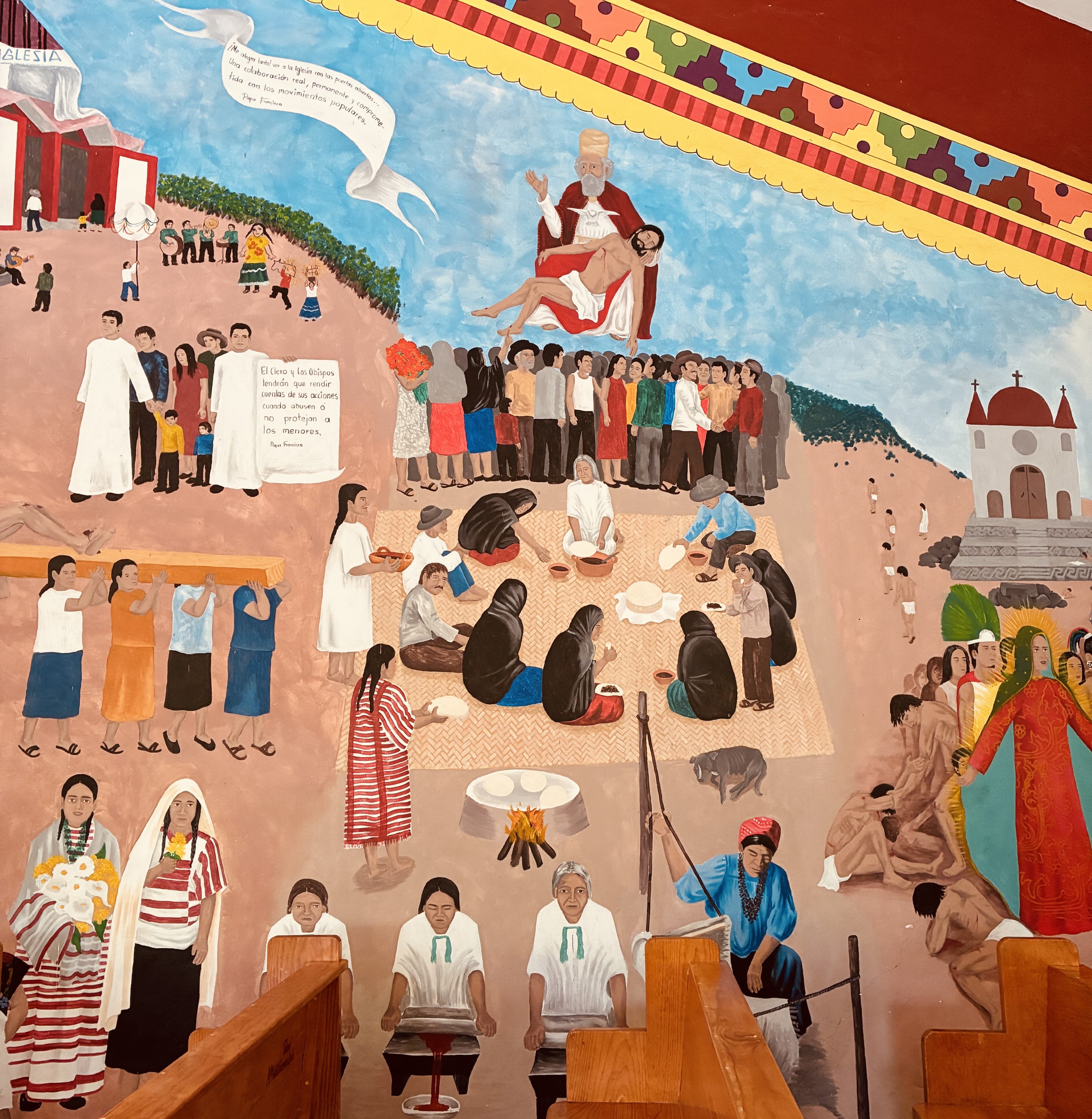
But the murals on the wall, I realize as my attention drifts, are radical. Indigenous campesinos in traditional dress – shawls and brightly colored skirts for the women, sombreros and linen pants and huaraches for the men – sitting in a circle, sharing a pot of beans and a stack of fresh tortillas. Above them a brown Jesus lies dying in the hands of a brown God. On a stone beneath them is inscribed a quote from Pope Francis: “There have been many and grave sins committed against the original pueblos of America in the name of God.”
In Cincinnati, Ohio, where I grew up, the chaplain of Children’s Hospital was arrested by ICE at a routine court check-in. He was granted asylum in 2018, but his asylum status has now been terminated. “I didn’t come to America seeking a better life,” he told the local news. “I was escaping death.” If deported, he will be sent back to Egypt, where he was almost tortured to death. On Facebook, comments varied. One was a meme of a founding father, with his long white wig and powdered white face, saying, “BYE!” Another read, “He prayed over my dying grandson.”
My close friend in Oaxaca tells me she has cancelled a trip to meet her newborn nephew. She does not want to risk her husband, who is Mexican and dark-skinned like my husband, ending up in a for-profit jail or worse, El Salvador or Venezuela. She knows that if this happens she will have no power or legal recourse, no due process.
“Is it really that scary?” she asks me. “Because I’m terrified.” She is not someone easily terrified. She casually evicts scorpions from her house on a regular basis, posts lighthearted tales about her flight making an emergency landing at a tiny coastal airport. But she will not return to the United States. “It is actually that scary,” I tell her. I warn her not to come. I tell her about Jorge getting followed by a broken-down truck in the suburbs and flipped off by angry white people. I can’t believe how normally I recount this. I am embarrassed for us, that this is how we live. That this is what we tolerate. We are walking on a beautiful road behind her house with our Mexican American children. A huge, full July moon rises above the valley. Pale white moon over lavender valley at dusk.
The congregation rises and follows the priest into a small alcove, where the holy water waits in a marble bowl. The bowl rests on a wooden stand, at the base of which are carved clay figures: an iguana sticking out its ropy tongue; a gaping pig. This is not your nice white Catholic church. I imagine a furtive group of liberation theology idealists infusing the church with indigenous symbolism and belief, and then remember that of course, this has been happening in Mexico ever since the conquistadores brought the idea of Jesus Christ to Mesoamerica six hundred years ago. Syncretism: the merging of belief systems.
On the far wall of the church is a dramatic mural. One one side, the Virgin Mary, in a glowing red dress and turquoise veil, shields the village from the arrival of the conquistadores. In full armor, on horses, they thrust their shields at her neck. They have set fire to the pyramids of the local Zapotecs, which burn in the background. Atop one pyramid is a large wooden cross, on which are painted brown faces contorted in agony. On the other side, everyday people gravitate towards a brown prophet wearing simple linen clothes. They are carrying backpacks and walking sticks and are trailed by thin dogs. They are mothers, children, families. They carry flowers and bags of goods.
On a stone among them is inscribed,
“The Virgin Maria: a mother without a roof who knew how to transform an animal’s cave into the house of Jesus with a few diapers and a mountain of tenderness. Maria is a sign of hope for the pueblos who suffer birthing pains until finally justice is born.”
I read about a farm raid in California in which one migrant is so panicked he leaps from a greenhouse and breaks his skull and spine, later dying from his injuries in a hospital bed. What pueblo did he come from? What house was he building there? What fruit, what vegetable did he pick, and what American is lifting it to her mouth right now, biting into its succulent flesh?
The baby does not cry. The water drips crystalline down her tiny face. Everyone leans in, awed, 2026 years after the birth of Christ, at this simplest ritual. Sunlight, marble, water, faith. So much we want and crave and kill each other for, and still we find awe in the most basic elements. After, the priest lectures and the small group of plainly dressed local adolescents sing, and then comes my favorite part: we turn to one another and say, “Paz, paz.” Peace, peace. Handshake, peace. Your human face. Your human face. Baby, grandpa, dying, just born. Outside the mountains, the great kiskadee. Because it is Mexico we sometimes kiss one another’s cheeks as well. Peace, peace.
Jorge does not travel to LA as planned because all of the basketball tournaments are cancelled. There will be no joy or celebration. People are too afraid to go outside. They still go to work, of course. The country still runs and will run on immigrant labor. No righteous white Americans are eagerly lining up to milk the cows, to pick the strawberries, to inhale the chlorine in the chicken slaughterhouses, and no one seems too eager to advocate for better working conditions in these places. Bailey Fischer of the Pennsylvania Farm Bureau, interviewed in the Penn-Capital Star about ICE raids on PA farms, explains, “Trust me, we have tried every possible solution you could think of, but the domestic workforce is just not there in the Ag industry. A lot of Americans, they prefer the office job over getting up at 4 a.m. to go milk a dairy cow or be out there in the hot summer heat, picking lettuce, harvesting lettuce, or fruit, etc.”
The U.S. Representative for the district, Republican Glenn Thompson, a close supporter of the President, whined to the Star, “Don’t disrupt the food supply train!” The administration backs off raids on meatpacking plants and farms, many of which heavily recruit in Mexico and bus their workers northward from the border. The “rules” apply apparently only when they will provide a nice show for, but have zero impact on, white Americans profiting from immigrant labor. ICE then raids elementary school graduations. Home Depot. Street corners where vendors are selling shaved ice to children. Restaurants. Churches.
The mass is still going on. The Mexicans do not cut any corners with their masses. Jorge enjoys watching me mouth how much longer every few minutes. He grins, shrugs. Finally it is time for communion. People line up and accept a wafer on the tongue from the priest. “What is that?” Elena asks, and I whisper to her that it’s the body of Jesus Christ, and they eat it, and it represents how they are one with Jesus Christ. She looks pale. For a while, she is silent, and I wonder if she is having profound thoughts about the oneness of all beings, about how we are all flesh disintegrating into the earth to feed beetles and trees. Then she speaks. “I’ll never look at a wafer the same way again,” she says.
It is ironic that the Americans so intent on persecuting immigrants actually have far more in common culturally with them than with many of their fellow Americans. The Mexican immigrants in that church, baptizing their children, work eighty-hour weeks. They sweat and toil harder for their families than any middle-class American I’ve ever met. They work nights disposing of hazardous chemicals, twelve-hour shifts at long-term care facilities, six days in a row in hospital cafeterias. One, who was “illegal” until Reagan’s widespread amnesty in 1986, slept in a tent for months, working in tomato fields in New Jersey. The mosquitos were brutal. They believe in God. They are anti-abortion. They are socially conservative. They stand here in this church with their babies clad in white, and they offer prayers for their children to be humble, patient, and kind. The priest asks the infant for her thoughts on the baptism. She leans forward, then tries to eat the microphone.
On a mural on the wall of the church, a woman prepares a massive pot of stew underneath a mesquite tree. Next to her is a stone on which is written this inscription:
“Let’s declare, together, from the heart:
No family without a home.
No peasant without land.
No worker without rights.
No village without sovereignty.
No person without dignity.
No child without a childhood.
No youth without possibilities.
No old person without a venerable old age.
– Pope Francis.”
Afterwards, at the party – because of course, there’s a party, with a pot of food big enough to feed a village, and esquites and chelas and refrescos and cupcakes and music and piñatas – Don Manuel, aged 94, takes a photo of his four granddaughters. Three live in the United States. The youngest has been changed out of her white lace into cotton pants and a matching shirt bordered in ruffles. The flash shines bright on her, in the center, little fist in her mouth, newly saved.
Archbishop Alberto Rojas declared the ICE raids in California a violation of due process and of “the dignity of the children of God.” After ICE entered a church and dragged people out of the congregation, Bishop Rojas made a statement: “We join you in carrying this very difficult cross.” The Jesuit Friar Brendon Busse described arriving on the scene after ICE had rammed a car in Los Angeles, violently removing the driver and leaving his wife and screaming children in the backseat. “There’s these masked men just going around kidnapping people,” he said. Michael Pham, a Vietnamese refugee and head of the San Diego diocese, accompanied immigrants to their asylum hearings and encouraged other faith leaders to do the same. On the day they were present, no one was arrested, and ICE agents quietly left. “I think our presence there made people examine their conscience,” the spokesperson for the diocese said. A Nashville church saw its congregation diminish by half because of the raids; the Tennessee Catholic diocese put out an official statement declaring that no Catholic had to attend mass if it threatened their safety. The executive director of the Tennessee Catholic Conference told the National Catholic Reporter, “There is an unusually heavy police presence around our parishes.” The Roman Catholic Diocese of Phoenix put out an official statement. “Today, as the Church of Phoenix,” it reads, “we raise our collective voice and hearts in prayerful solidarity with our immigrant brothers and sisters…These men, women and children–many of whom have fled economic hardship, violence, and political instability–come to our land seeking refuge and hope. They are not statistics; they are our neighbors. They are members of our parishes, our schools, and our communities. They are members of the Body of Christ.”
The wafer dissolving in the mouth. A steak, cut and cleaned and packaged by the swift brown hands of a hungry and tireless teenager. A sweet strawberry smeared with the blood of someone hunted like an animal. Sweat in the asphalt of a newly paved highway, driven by people who talk primly about rules. Fear pheromones in your fajitas. The bedsheets at the hotel loose at one corner, because someone ran, for her kids, for her life, before she could finish. Her perfume still in the room, on your skin, now, as you lay down to rest. This is our American communion.
Keep reading with a 7-day free trial
Subscribe to Terms of endearment to keep reading this post and get 7 days of free access to the full post archives.